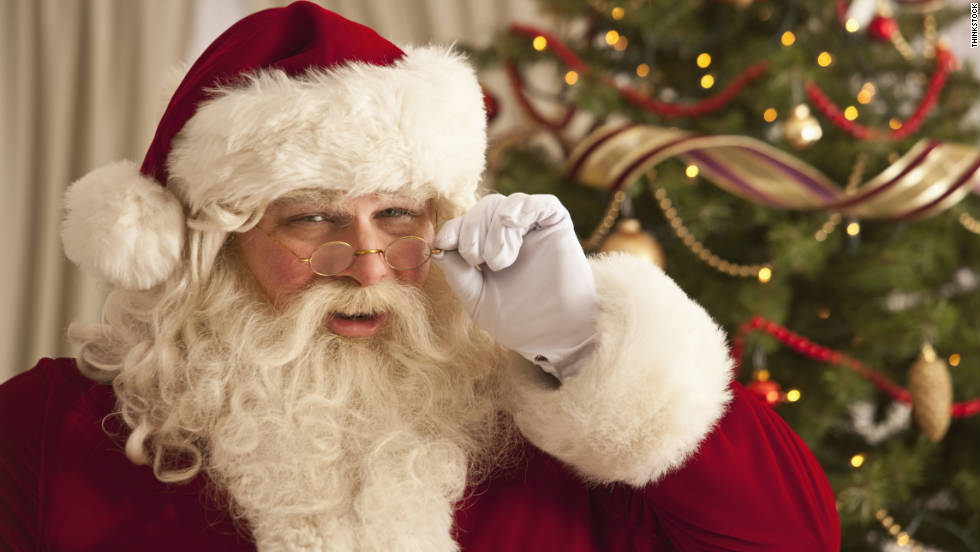
Why I Wouldn’t Teach My Kids About Santa

I don’t actually have a problem with Santa Claus.  In fact, I enjoy the general holiday cheer, even if it isn’t specifically Christian.  I’m fine with songs like ‘Santa Claus is Coming To Town,’ ‘Frosty the Snow Man,’ ‘Silver Bells,’ etc…  Its all good fun.  But of course, I appreciate the Christmas songs that contain robust theology even more.  Taken as a whole, I simply enjoy anything that is associated with the month of December and all the nostalgia of Christmas time.  I say this because I want to be clear that I am not a Christmas curmudgeon, a Grinch, or a Mr. Scrooge.  I actually love everything about this time of year, including Santa.  But I know for certain that when I have kids I will never specifically teach them about Santa Claus.

I’m fine with my children watching Santa movies and picking up bits about Santa Claus lore along the way.  I’m not at all interested in sheltering them from the broader culture’s Christmas tradition.  Basically it all boils down to the fact that I don’t want to lie to my children.  I’m not terribly concerned about ‘distracting’ them from Jesus’ birth.  This is a real concern to be sure, but I don’t think that general Christmas mythology about talking snowmen, flying reindeer, or Santa Claus is inherently problematic.  As long as Santa remains within the world of cartoon characters, action figures, and comic-book superheroes then I have no problem with Santa.  The issue for me is the idea of lying to my children at such an impressionable age.  As skepticism brews in various post-Christian parts of the world, I wonder if Santa mythology might perpetuate the abandonment of faith among children reared in Christian homes (for earlier discussions about this issue on our blog see Part One and Part Two of Tanner’s posts on the documentary Divided?).  When you’re young, you believe everything your parents tell you. In many ways, your survival depends on this.  For instance, you don’t cross the street, as your mother told you, and so avoid getting hit by a car.  And again, you don’t drink the cleaning solution under the sink, as your mother warned you, and so you avoid poisoning yourself.  What your parents tell you is important for your survival.  Furthermore, your parents shape your developing worldview.  They instill you with values and traditions that will carry with you for a long time.  So when a family teaches their children about Santa and convinces them to believe it for a number of years there is potential for major cognitive dissonance.  It might seem like I’m making too much out of something innocuous, but it sets an unnecessary precedent.   Questions could immediately come to a child’s mind: if mom and dad lied to me about this, what else have they lied to me about?  This thought is ultimately what deters me from ever teaching my children about Santa.

But the one thing you will hear me teach my children about Santa Claus is his role in the Council of Nicaea.

Say what?

Yep, its true.  St Nicholas was an ardent supporter of the Council and strongly opposed the heretical teachings of Arius (who believed that the Son of God was a created being, and not eternally co-existent with the Father and the Holy Spirit).  In fact, at one point St Nicholas ran over to Arius and slapped him across his face!  Now that’s a Santa Claus I could tell my children about: the kind who jealously loves Orthodox Trinitarian theology!

So, what do you think?  Am I being too dramatic?  Would you teach your children about Santa?


John Anthony Dunne

You might also enjoy…

22 responses to “Why I Wouldn’t Teach My Kids About Santa”

  1. Nice blog post. 🙂

    I will definitely pull the grinch card here and say that not only will I not get my kids wrapped up into Santa, but we also probably won’t do most of the pagan traditions that have ruined the real meaning of Christmas (though Pagan itself…).

    I don’t want my kids to be freaks and have a family that refuses to celebrate Winter holidays so I will make it look different. I will definitely put an emphasis on advent, and try my best to twist certain traditions towards Jesus. This will most definitely include a lot of giving and not receiving. I will also teach my kids about Hanukkah during this time, because really – Hanukkah is an awesome celebration – so much history!

    The sheer thought of what Christmas and Santa stands for these days – presents presents presents, make me so sad.

    1. John Anthony Dunne

      Carrie, thanks for your comments. I want my kids to know the real meaning of Christmas just the same. I will make that abundantly clear and reinforce it as much as possible. This includes criticizing culture’s over-indulgence in consumerism as you mentioned. I didn’t dive into that too much because I suspect someone else on our blog will tackle that (and if you’d like to here’s an open invitation). That being said, I don’t mind the larger cultural spirit of Christmas in Western culture. I can enjoy it for what it is and at the same time see how the whole point of the holiday is Jesus. I can keep these in balance, and I know others can as well. I hope to teach my kids how to balance it.

        1. John Anthony Dunne

          These are brilliant pictures! We have a great one of my little brother on our frig. It would fit perfectly in that group. Santa’s face in the picture is priceless!

  2. These are all legitimate and valid points you make. The only silly worry I have by doing this is having the fear that my child will be known as “that kid” who doesn’t believe in the ultimate fairy tale of the happiest season of all. But at the same time, if my kid were to honestly ask me if there is a Santa Clause, I wouldn’t be comfortable endorsing this belief, because the Holy Spirit convicts me on everything.
    I will definitely tell my children that St. Nicholas was a supporter of those disagreeing with truth! 🙂

    1. John Anthony Dunne

      Yeah if your kids ask you about Santa and you lie to them that’s messed up. And I don’t think you should have that silly worry. I doubt your kids will feel dumb for not believing in something thats not real! They might even thank you, in fact. But dude, I think you misread my comments about the historical St Nicholas. He endorsed the orthodox view and punched the heretic for teaching false doctrine.

      1. So, he punched the people who disbelieved in God, right? So, we applaud that! Right? You are correct bro, they will thank me 🙂

        1. John Anthony Dunne

          Well Arius believed in God. He just didn’t believe that Jesus was fully God. He understood Jesus to be divine in some sense as the first and greatest of God’s creatures, but he did not regard Jesus as a member of the Trinity or fully God. But yes, you’ve got it straight. St Nicholas punched someone who was teaching that Jesus wasn’t God.

  3. Good post, John! I’m grateful my parents never had us believing in Santa. If you’d have asked me a few years ago, I would’ve said my biggest problem with Santa is that his presence detracts from Christ. Now I feel that his presence, as well as that of Frosty, Rudolf, etc, are just about as inoquous as Batman or Spongue Bob Square Pants. The same danger in being distracted from Jesus exists year around if we allow any fictional character to dominate our time and thoughts. Christmas time is not unique. And really, if it weren’t for Santa and other non-Christ related Christmas lore, we probably wouldn’t be celebrating the holiday all month long. So can we really decry Santa’s presence in our culture the first three weeks of December?

    My bigger problem with Santa is the same as yours. It involves lying to your kids. Besides, if I spend my hard-earned money on their gifts, I want to be the one receiving their gratitude (Just kidding. Kinda.). And finally, I don’t want to breed anti intellectualism in my kids. As John Malcovich points out in his reading of “Twas the Night Before Christmas,” (http://www.hulu.com/watch/47611/saturday-night-live-twas-the-night-monologue) in order for Santa to make it to the houses of all the kids in the world, he’d have to be traveling so fast that his sleigh would create such an enormous friction that it would literally burst into flames. I don’t want my kids to be dumb enough to believe in this Santa.

    1. John Anthony Dunne

      Thanks Caleb. You’re totally right. When you keep Santa on the level of Batman he’s good fun! And if my kids can watch Sponge-Bob cartoons, they can easily watch Santa movies. And if the kids ever ask if Santa is real, its the same as asking if Sponge-Bob is real. I also appreciate your point that Santa has helped to keep the holiday in Western purview. Perhaps unwittingly this myth has brought about many Christmas conversions? I wouldn’t doubt it. If God can use an ass…

  4. Haley

    I’ve been thinking about it since you posed the question a few weeks ago.

    Like everything in life, I think it depends an awful lot on our own personal experiences, particularly when it comes to anything regarding religion. If one was not led to believe in Santa as a child, they often consider themselves fortunate for not having “been lied to,” or on the other hand, if one was led to believe in Santa and then had the truth of Santa’s existence shatter their understanding of reality, they naturally want to resist allowing their own children to have that same terrible experience. And yet, there are those (including myself) who believed in Santa for as long as they can remember, and have no recollection of learning the truth of the matter, but like most kids (I imagine), they naturally came to an age of maturity when they intuitively realized the truth of the matter and they thought, “oh well.”

    What makes Santa any different than the Easter Bunny or the Tooth Fairy? Will your children not be putting their teeth under a pillow at night either?

    It’s the world of imagination, the reality of a child’s world, in which Santa and the Tooth Fairy exist. It’s that same imagination that we see dissapearing in kids today due to video games, tv, etc. rather than creating worlds out of sticks and mud. I can’t imagine how the world of Santa hurts this disappearing imaginative reality in our kids today; rather, I imagine he fosters it.

    On a quick and final note, if my children lose their faith or question what else I have lied to them about upon learning the truth of Santa, then it still may be my fault, but it will not be due to Santa. Those are signs of much larger “bad parenting” issues.

    1. John Anthony Dunne

      Haley, thanks for commenting! I’m totally fine with imagination! I’ve got a huge one myself! I love Batman, Harry Potter, LOST, Lord of the Rings, Star Wars, etc… I’m a huge nerd with an even bigger imagination. I have no problem with Santa mythology as long as its keep on this plain. I did note in the post that I’m fine with my future kids watching Santa movies and learning all about his mysterious Santa ways, but I just will simply never tell them its real or encourage their imagination to assume its real. They can dream and play all they want! And I do hope they play in the mud often. But it just comes down to issues of reality and truth. Thats the difference for me. I’m completely on board though, the only thing for me is that I won’t tell them he’s real.

  5. Michael

    Well said John! I agree with you wholeheartedly. I was actually quite traumatized when I learned of Santa’s non-existence. After years of my family going to great lengths to perpetuate this ‘tradition’, ranging from forged notes that Santa left to Rudolph impersonations outside the window, I was left with the horrible truth that my parents had staged this all of my life. Instead of it being good fun, it was really disappointing and cause for questioning other things that I had been told.

    Thanks for the post and the historical bit on Ol St. Nick.

    1. John Anthony Dunne

      Mike, thanks so much this! I didn’t have hard statistical evidence when I wrote this. Just a hunch and strong feelings. I’m glad that you shared this aspect of your childhood with me and other readers. This is the sort of thing I imagined and feared. It makes sense to me that you were hurt and skeptical afterwards! What a major hoax they played on you. I truly do wonder about the potential this sort of thing has on psychological development in children. Now I want to go get a PsyD and write a dissertation on Santa mythology in adolescent psychological development!

  6. My parents always made it clear that the Christmas presents were from them, not Santa. This helped me develop a healthy suspicion of superstition, especially when combined with the teaching that there really is no such thing as good and bad luck.

    1. John Anthony Dunne

      Thanks for this comment! My parents did similar things. We always put out Dr. Pepper and cookies instead of milk and cookies because my dad would come home from work late at night (he works in the casino business). But I like how it affected your view of superstition. Thats good to know.

  7. Justin Gum

    I think this is simply a case by case issue. Many children, depending on the way the parents brought them up as well as mannerisms and what behavior the child exhibits upon discovering things and etc, differ. I wasn’t explicitly taught that Santa was real but came to believe that Santa was real because of the presents under the tree, signed Santa.

    If I had become traumatized upon my discovery that it wasn’t Santa, but my parents, who left the presents, would this have changed their responsibility in the matter? Regardless of that issue, I’d like to believe that I live a relatively normal life after finding out Santa isn’t real, as well as the tooth fairy and unicorns. I sin, I repent, I pray for strength. But I don’t doubt that one’s belief could’ve been so fundamental and rooted that it would have utterly destroyed them. But it wasn’t for me. And that’s the point. My parents were not actively seeking to tell me Santa was real because they focused on what was so important about such a Holiday like Christmas.

    At the same time, I am going to sign my presents with Santa’s name. I have no shame in that because I want them to have the opportunity to foster their development in believing, imagination, and just plain logic, as that was how I got to stop believing in Santa. But I totally understand how some parents wouldn’t want to do it and I’m okay with that.

    1. John Anthony Dunne

      Justin, thanks for your comments. Of course, we’ll have to agree to disagree. I don’t have a problem with other parents signing gifts from Santa, but again, I just don’t want to be deceptive. I’m all about imagination, so I hear your concern. I’m a huge nerd myself with an even bigger imagination. I definitely want to foster that, which is why I’m fine with Santa as long as he is in the category of Spiderman, Luke Skywalker, and Kermit the Frog. I just don’t want him to be anything else for my kids. As you said, you weren’t traumatized and I pray that kids won’t be traumatized, but I have a genuine concern that this sets up an unnecessary precedent of deception with my children (I should say I feel the same about the tooth fairy and unicorns).

  8. […] Why I Wouldn’t Teach My Kids About Santa […]

  9. Joseph

    I do not celebrate Christmas , scholars place the time of the birth of Jesus Christ sometime in the early spring, early Pagan converts to Christianity chose december 25th as a date to coincide with the winter solstice……Christmas has nothing to do with Jesus or God….So what is the real meaning??

    1. John Anthony Dunne

      Joseph, thanks for your comment. I’d recommend reading Caleb’s recent post on our blog since it answers the question about the origin of Dec 25th directly (In the 4th century the bishop of Rome chose the date not “pagans.” See: http://www.thetwocities.com/culture/christmas/the-pagan-roots-of-christmas/). I hope you find the rest of that article helpful as well.

      But allow me to say one thing as a direct response to your question. The date of christmas is arbitrary. We do not celebrate Dec 25th because it’s accurate. We take a day out of the year to commemorate the incarnation. Whatever the origin of the date is matters very little. Rather than being concerned with where something is derived from, we should be concerned with where that thing is going. By placing our celebration of Jesus’ birth at the same time as pagan celebrations, this does not mean that Christmas is pagan, rather it demonstrates that Christmas confronts the pagan worldview head-on. It declares emphatically that Jesus is the true substance to which these other celebrations are but a shadow. So to say Christmas has nothing to do with Jesus or God is, to put it bluntly, immature. The date is immaterial. The whole point is a celebration of the incarnation. Hopefully you take some time this year to do just that. Blessings!

  10. Leandra Johnson

    The reason I never led our boys to believe in Santa Claus, is because it infringed on the most wonderful, true story of God’s gift of love and redemption. I wanted nothing to detract from that.

Leave a Reply to Justin Gum Cancel reply

Your email address will not be published. Required fields are marked *