
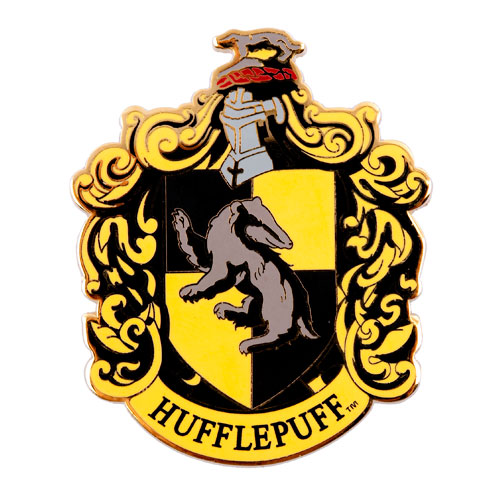
Every fan of Harry Potter has envisioned themselves as belonging to one of the four houses of Hogwarts. Ask any fan and they’ll tell you. For myself, I know I am not courageous enough to be Gryffindor and so I’ve always identified with Ravenclaw; not because I am particularly drawn to characters from Ravenclaw — such as Luna Lovegood, Cho Chang, or Prof. Flitwick — but because of their emphasis on academics. For a guy who spends most of his life studying, Ravenclaw is a natural fit. Most fans naturally identify with Gryffindor because the characters from Gryffindor are the protagonists and the ones that are most developed. Of course, many dissenters with an ambitious edge to them find Slytherin House appealing. But what you’ll often find is that virtually no one wants to align themselves with Hufflepuff. Anything but Hufflepuff! I remember the look of shock in a friend’s face when I said he fit the description of Hufflepuff quite well. For most, being a Hufflepuff is not a compliment; it’s an insult.
Part of the problem with Hufflepuff is that we simply don’t know much about it. Few characters from Hufflepuff are introduced and the one who gets the most attention – Cedric Diggory – is killed off in the same book that first develops his character. But perhaps the de-emphasis on Hufflepuff in the narrative was designed to point to particular values about the house: humility and equality. A striking episode from Order of the Phoenix points in this direction.
When everyone returns to Hogwarts at the start of the new year — the year after the Tri-Wizard Tournament, the death of Diggory, and the return of Voldemort — the Sorting Hat sings a new song. The Hat retells the origin of the school and why Hogwarts was split into four houses—essentially explaining the nature of his job. As he recalls, the four founders of Hogwarts were originally united…
“Together we will build and teach!”
The four good friends decided
And never did they dream that they
Might someday be divided (p.204).
Then the Hat notes the distinguishing visions of the four founders:
Said Slytherin, “We’ll teach just those
Whose ancestry is purest.”
Said Ravenclaw, “We’ll teach those whose
Intelligence is surest.”
Said Gryffindor, “We’ll teach all those
With brave deeds to their name,”
Said Hufflepuff, “I’ll teach the lot,
And treat them just the same.” (p.205)
The Hat then narrates that Slytherin took only pure-blood wizards of great cunning, Ravenclaw the sharpest of mind, and Gryffindor the bravest and boldest. Then the Hat says, “Good Hufflepuff, she took the rest, And taught them all she knew.” The Hat declares that Hufflepuff was ‘good’ and appears to explicitly commend her actions. She took everyone and she taught everything. She didn’t compromise her teaching in expanding her acceptance.
When I think about the view of many fans regarding Hufflepuff I wonder what this reaction might actually convey about ourselves. Do we sort out who we’ll befriend or who we’ll merely remain acquaintances with based on certain qualities? Do we as Christians withhold sharing the gospel from, or extending love to, people based on certain conditions, whatever they may be? Do we as churches ostracize or exclude people that don’t fit the established ethos? Are we as welcoming and accepting of people as Christ was? As for myself, I think I’m tired of hating Hufflepuff. I’m afraid of what that means about myself as a Christian and as a human being. Sure, on Pottermore and in personality tests I know deep down I’m a Ravenclaw, but for the sake of the Gospel, I’m a Hufflepuff.


Leave a Reply to Mandy Cancel reply