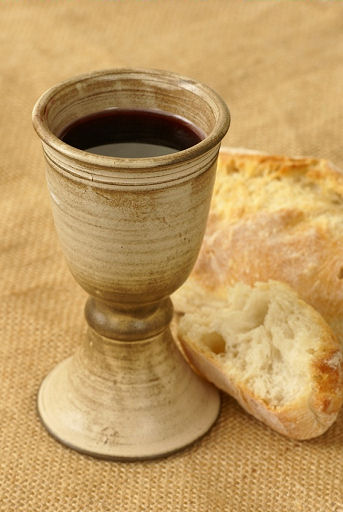
Eucharist & Eutychianism

I just have a few thoughts about the Eucharist for today (aka The Lord’s Supper, aka Communion, aka The Sacrament, aka That Thing Your Church Doesn’t Do Enough). I am mostly interested in hearing responses from others who have thought more deeply about this topic. I inherited a fairly low church view of the Eucharist from my church background. Of course, I wouldn’t have known it at the time, but my perspective was essentially Zwinglian—I believed it was purely and solely a symbol. In fact, the materials used in the celebration didn’t matter at all. My Jr. High youth pastor once had us celebrate the Eucharist with orange soda and chips (no joke). At the time this seemed like a great exercise in reminding our little evangelical selves that all God cares about is the heart, and so who really cares about outward forms and traditions? I eventually stopped thinking that such a disregard for tradition was helpful, especially when considering all the wonderful Passover theology inherent in the bread and the wine. And, since we mentioned wine, I never had wine as part of communion until last summer when I lived in Paris. It took me as a great surprise when I drank what I thought was grape juice! But once I noticed the ascetic beauty of the wine’s sting I was immediately drawn to think O Death, where is your victory?! O Death, where is your sting?!  It was beautiful. I wish that evangelical churches would be more open to wine in the Eucharist. . .

As I’ve gotten older my perspective on the Eurcharist has journeyed away from Zwingli towards Calvin. I can’t say that my view is totally Reformed, but I want to maintain some sense of “presence” or significance that goes beyond mere symbol. But, of course, I refuse to think of this “presence” in any way other than spiritual. I have biblical reasons for this, but I want to mention a particular theological reason that has always stuck with me (perhaps because I’ve yet to hear a good rebuttal—that’s where you come in!). The theological hang-up I have is this: if Christ’s humanity is present in the Eucharist haven’t we become Eutychians?

I like to refer to any view of the Eucharist—Lutheran, Reformed, Orthodox, etc—that speaks of Christ’s humanity as receiving qualities or attributes akin omnipresence in his exalted form (and therefore in some sense present in the Eucharist) as a ‘postponed Eutychianism.’ Sure, Chalcedon will be defended by these traditions to the grave—Christ is fully God, fully man, two separate natures united in one person. But of course, Eutychianism blends the natures so that attributes and qualities of each mix into each other. So, if Christ’s humanity is present in the Eucharist, why isn’t this a form of postponed Eutychianism? If you’re a Catholic or Orthodox reader, this is not a debate; I’m genuinely curious to see how this issue is addressed within your tradition. I’d love to engage this discussion with you.

John Anthony Dunne

You might also enjoy…

4 responses to “Eucharist & Eutychianism”

  1. Dave

    The Lutheran view is that Christ’s humanity is present in the Eucharist, but it’s not the Calvinist (Reformed) view. In fact that is one of the distinctions between Calvin and Luther on the eucharist.

    1. John Anthony Dunne

      Dave of course! Maybe I didn’t make that clear. When I said I want to hold some sort of “presence” I was thinking of spiritual presence. I realize I didn’t say that, but I did disqualify physical presence with my statements about Eutychianism. So of course I know that important distinction between the Reformed and Lutheran view. I am almost at the Reformed view but could never go past it. That’s really what I was trying to say.

  2. […] A reply to John Dunne in ‘Eucharist & Eutychianism’. […]

  3. Mike

    John,

    I too come from an essentially Zwinglian background. I never substituted wine for Orange Crush, but I likewise was restricted to Dr. Welch’s Unfermented Wine for most of my Christian life. About a year ago I started exploring Anglican and Lutheran perspectives and now commune weekly at a Lutheran church where we partake of the body and blood of the Lord Jesus Christ “in, with, and under the forms of bread and (fermented) wine.”

    With the caveat that I am still learning the Lutheran sacramental theology, I wanted to take a stab at answering the question you posed: “if Christ’s humanity is present in the Eucharist haven’t we become Eutychians?” I admit that I had to look up the Eutychians and also had to look up the text of the Chalcedonian Definition. Forgive me; I’m a noob when it comes to pre-Reformation church history.

    Based on my extensive (ha!) research, it seems like Eutyches erred by teaching that Christ’s two natures blended in such a way as to create an entirely new kind of nature. To this, Chalcedon replied, “acknowledged in Two Natures unconfusedly, unchangeably, indivisibly, inseparably; the difference of the Natures being in no way removed because of the Union, but rather the properties of each Nature being preserved, and (both) concurring into One Person and One Hypostasis.”

    I’m not sure if I fully understand your concept of ‘postponed Eutychianism’, but I think your concern is that if Christ’s humanity is present in the bread and wine there is a sort of blending of attributes and qualities such that something with a new nature is created. A Frankenstein of Christ’s humanity, Christ’s divinity, and the material elements of bread and wine…? Or perhaps the concern is that if Christ’s humanity is present in the bread and wine and also present at the right hand of the Father that his being is being divided?

    There’s two things I would say to further the dialogue. First, what does it mean for Christ to be present in the Eucharist in a spiritual sense? Does this mean that his divine nature is present (as he is divinely omnipresent), but that his human nature (being bound as it is by temporal constraints) is absent? If yes, would that affirmation not run afoul of Chalcedon when it states, “not as though He were parted or divided into Two Persons, but One and the Self-same Son and Only-begotten God, Word, Lord, Jesus Christ.” Does Chalcedon allow for Christ’s natures to be separated in such a fashion? As the Wikipedia article on Lutheran sacramental union states: “The Lutheran scholastics described the Reformed christological position which leads to this doctrine as the extra calvinisticum, or ‘Calvinistic extra,’ because the Logos is thought to be outside or beyond the body of Christ.” (accessed 6/21/2014)

    Second, I wonder if a trip through ancient and medieval philosophy and metaphysics might prove useful. I know a few terms like substance and accident but I also know enough to know that I don’t know much about this topic.

    Hope this helps!

Leave a Reply

Your email address will not be published. Required fields are marked *