
Note: This review was written before professional basketball player Jason Collins came out as gay today in Sports Illustrated.
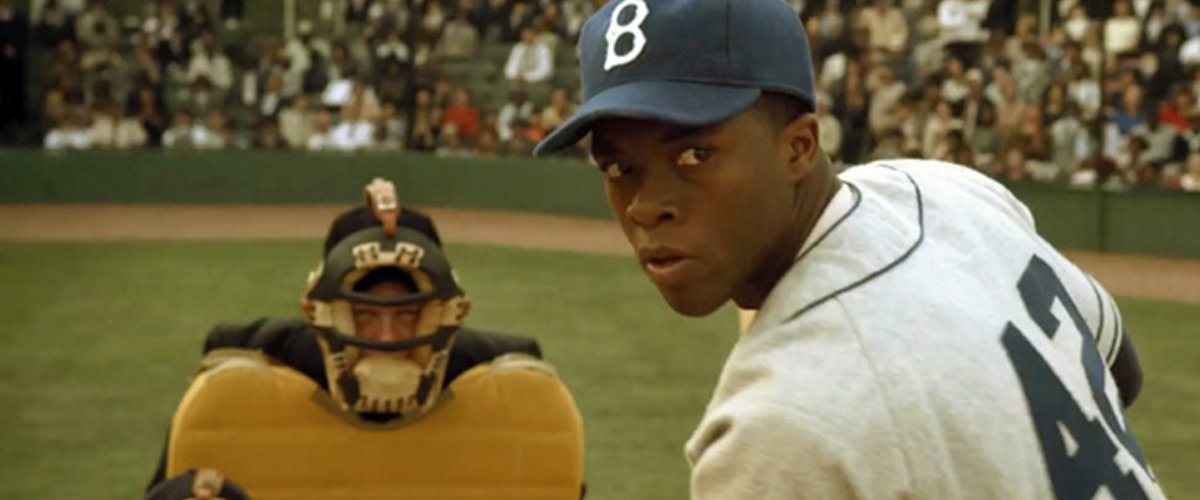
I saw the movie 42 tonight, and I have to say, I kind of enjoyed it. Yes, I know it was extremely sentimental at some points. During certain scenes I could have sworn I was going to get a cavity from all the sugary sweetness of those early heart warming familial moments. That being said, I felt, at the end, that 42 was the epitome of a feel good movie. It wasn’t a movie that you felt forced to feel good in (all the time at least); rather, you actually left the movie feeling good about life in general. It earned some of its most poignant “feel good moments”.
Ever since Angels took to the outfield for my generation, sports and specifically baseball films are where many storytellers go to create inspirational tales of teamwork and perseverance. There have also been quite a few sports films in the last twenty years that take on the issues of race and how that specific sport was one of the epicenters for social progression in the way in which that white people saw people of color.
So what’s so different about 42?
I’d like to make the argument that 42 isn’t really about race. While on the surface race is what the film seems to be discussing, to say that this is another movie in a long line of films about race seems to be a bit reductive. Rather, I believe 42 allows us to begin a conversation on an issue that is currently filling the headlines recently: openly LGBT athletes in professional/collegiate American sports.
But first off, I want to address something you’re probably thinking: I am not in any way trying to say that we live in a post-race America and that race doesn’t matter anymore; that we’ve somehow ‘arrived’, therefore making a movie about progressive race theory irrelevant.
Take a look at Doug Gottlieb’s comments during CBS/Turner’s coverage of the NCCA tournament a couple of weeks ago and the vitriol his race based joke stirred up, as a brief but recent example of our latent issues with race and ethnicity. If you’re not convinced of our society’s hang ups with issues of race, you can also look at the even more recent blogosphere clamor over Brad Paisley and LL Cool J’s sultry duet in the song “Accidental Racist” off Paisley’s new album released this past Tuesday. In spite of all this (i.e. I hate to sound like I’m ignoring these issues of race), I believe that this film has something different to say to us. 42 is not solely about race. Race relations in America is an issue, that while still fraught with areas for growth, is something we feel like we’ve made significant progress on (which I do believe we have). Rather, 42 looks at a group of people that the sports world hasn’t yet come to terms with in the majority of our everyday lived experiences.
[Possible Spoiler] There’s a scene when Brooklyn Dodgers owner Branch Rickey is telling baseball star Jackie Robinson why he did bring a black man into a white man’s game. Rickey references his time at Ohio Wesleyan University, where he had a black ball player who got beat into the ground (i.e. was never allowed to reach his potential) because of the color of his skin. Branch talks about how he did nothing to help this man when he had the chance. He realized then that there was something fundamentally wrong with the game he loved if it couldn’t handle having a black man (who had the skill and the talent) playing the game that he loved so much.
There are other moments in this film where you wonder if the lines of bigotry aren’t meant to make us feel better about our progress in race relations, but actually to say to us, look at how similar some of you sound to Ben Chapman calling Jackie Robinson a ‘nigger’ and a ‘tar baby’ except you’re not targeting black people, you’re actually targeting members of the LGBT community.
The point is to point out that perhaps there is something fundamentally wrong with a nation whose sports systems can’t figure out a way to have openly LGBT professional/collegiate athletes playing on the same field, court or ice rink with openly heterosexual professional/collegiate athletes.
Ironically, all the issues Robinson had to overcome (vitriolic fans shouting slurs, locker room tension [you can’t tell me modern day athletes don’t feel the same way about openly LGBT athlete’s in the showers as Robinson’s team did him as a black man early on], media firestorms, etc.) are probably on par with what the first openly gay or lesbian super star athlete will have to go through some day in the near future.
As I was driving home, my wife mentioned that it was crazy that before Jackie Robinson, there were no players of color in the majors. Zero. None. And yet all it took was one man, one person brave enough to take on a whole societies way of thinking, to actually bring about change in the game we call America’s past-time.
Perhaps this next time around, it will be a football player. It is the highest grossing sport in America today. What better platform for a historic moment like this to occur on? The bottom line is that no matter who this person is, they will not have an easy road to travel. One of the only encouraging things for them will be the fact that they will not have been the first to take on the tumultuous journey towards equality in a world that does not seek to understand who they are or why they play.
 Justin Campbell is a Graduate Teaching Fellow studying Creative Writing at Loyola Marymount University in Los Angeles, Ca. His work has been published or is forthcoming in The Conium Review, The Faircloth Review, Margins, The Wide Net Literary Magazine, and Elephant Tree Literary Magazine. He lives with his wife in Whittier, CA.


Leave a Reply to Boys, It Is All Hell | The Two Cities Cancel reply