
Much could be said about the movies of 2014: from talking about the Biblical adaptions (or from the book of Enoch) of Russell Crowe’s Noah in Noah and Christian Bale’s Moses in Exodus: Gods and Kings, to musing about Scarlett Johansson’s becoming super-human in Under the Skin and Lucy, to making some kind of pseudo-intellectual observations about the phenomenon of movie titled with single theological buzzwords such as Transcendence or Predestination.
I haven’t actually seen Noah or Exodus, and it is probably a bit far-fetched to try to draw out any major trends or recurring themes in the popular movies for 2014. Nonetheless I’d like to consider one theme that I think is heavily explored by many movies in 2014: The meaning and finitude of humanity.
Firstly, the temporal finitude of humanity— Predestination obviously explores the issue of time-travel, whilst Interstellar is strictly not a movie about time-travel, similar themes are perhaps the most discussed elements of the movie. And, of course, there is also X-Men: Days of Future Past… (with which I am still not convinced about how Patrick Stewart’s older/future Professor X came back from life after X-Men 3…)
Secondly, and I think more importantly, the meaning of humanity, or perhaps human ‘finitude’ in terms of what are the boundaries of what we’d define as human. Well, X-Men obviously raises the question of ‘what is human?’ (e.g. are mutants ‘human’?). Similar questions are also raised about to what extent is it dangerous for humans to challenge their current finite nature — as in Transcendence and Lucy.
But perhaps, above all, I think there are two movies that are very loosely connected — just by a character’s name — that illustrate (at least) two different meanings of post-humanism:
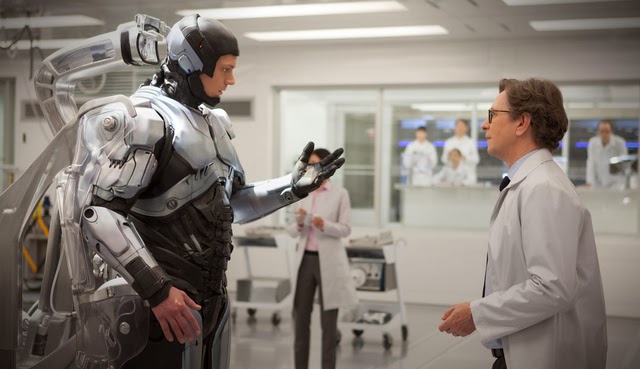
- RoboCop (2014) considers post-humanism as transhumanism, namely transforming human ‘nature’ through scientific and technological ‘enhancement’ — in a sense, the compatibility between human nature and human culture. Now, this 2014 remake features a US Senator who set-up the Dreyfus Act, which forbids robot use for police and military ends in the USA. This character, one of the good guys, played by Zach Grenier, is called Hubert Dreyfus — named after the world-leading philosopher Hubert Dreyfus, who in real life is a strong Heideggerian critic of artificial intelligence (see also Wikipedia on this).
– - Dawn of the Planet of the Apes, on the other hand, explores a different question — the difference between human nature and animal nature. This time, the character also called Dreyfus, played by Gary Oldman (who also plays Dr. Dennett Norton, named after Daniel Dennett), one of the bad guys, as tries to ‘save human race’ by seeking to make the human-ape relation irreconcilable. In this movie, apes have formed not only a community — with schools and all that — they their community is specifically linguistic In other words, apes are not only social, but also cultural animals. Furthermore, apes here not only have the capacity to speak to each other, but even to recognise themselves as apes, they self-identify as being apes — as opposed to being humans. The characteristic self-identification or indeed ‘self-interpretation’ — especially through social activity and cultural institutions — is precisely what the real life philosopher Hubert Dreyfus calls the essence of human being.[1]
*
Perhaps all of these observations are shaped by my own experience having recently taught a module on theological philosophical anthropology, but I hope they somewhat make sense.
What are your reflections on or favourites of 2014 movies?
[1] Hubert Dreyfus, Being-in-the-World (MIT Press, 1990), 23.


Leave a Reply to On Interstellar — and Super-humanity | The Two Cities Cancel reply