
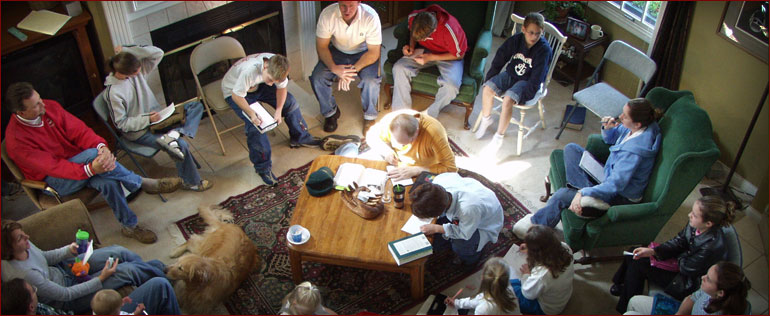
I am sure that to many, the title of this article made you roll your eyes a little bit. You know that the Bible talks about churches meeting in houses but… I mean, that can’t possibly apply to our cultural setting today. You also may have met some rather bizarre individuals who were house church advocates. Or perhaps, you don’t see how a house church could maintain good doctrine. My goal in this short piece is to show you that house church isn’t just a crazy idea for some far out there quacks but that it helps us to live out many commands of Scripture with tremendous affect.
Few would desire to challenge the fact that house churches seem to be the modus operandi during Biblical times (Acts 12:12; Rom. 16:3-5, 23; 1 Cor. 16:19; Col 4:15). While I freely confess that there is nothing in Scripture prescribing people to meet in house churches, there are several prescriptive verses that only seem possible to live out in a house church. And then there are other verses that, while not absent in the institutional church, seem like they are better lived out in a house church.[1]
Let’s start with 1 Corinthians 14:26 where Paul writes, “What then, brothers? When you come together, each one has a hymn, a lesson, a revelation, a tongue, or an interpretation. Let all things be done for building up.” I have hit on this verse over the past few weeks but I highlight it again to point out the fact that this is the ONLY place where Paul specifically describes what we should do when we are gathered together as a body of believers. If this is the only place where Paul tells us what our gatherings should look like, then it stands to reason that we should endeavor to create an environment where this can be lived out. It must be said that living out this verse is quite possibly the most important mark of a healthy church. House churches, being small, enable the participation of all members. And those leading the house church ought to encourage the others to bring something every week for the building up of the body. It is not one person’s job to build up the body but everyone must work at it together by bringing something each week.
The reason that Paul is able to write about everyone participating is because in the New Covenant, every believer is a priest, not just the hired staff. 1 Peter 2:9 reads, “You are a chosen race, a royal priesthood, a holy nation, a people for his own possession, that you may proclaim the excellencies of him who called you out of darkness and into his marvelous light.” House church enables all believers to live out of their “priesthood.” They are not second class Christians with less to contribute because they haven’t yet read enough books about hermeneutics or whatever topic. Those who are priests are those who have been called out of darkness and into light. There are no other qualifications to be a New Covenant “priest.”
Many protestant confessional statements contain an affirmation of the priesthood of all believers. However, if we look at the structure of the institutional church we have to ask if this is really being borne out. The priesthood of all believers does not just mean that you don’t have to confess your sins to a priest. It means much more. It means that all God’s people are able and capable ministers. If someone were to walk into an institutional church, would they be able to agree that all God’s people are equally “priestly.” Probably not. In a house church everyone is ministering to one another.
It is in this framework that Paul’s discussion on the Body of Christ in 1 Corinthians 12-14 makes most sense. There are indeed many members of the body. What is not considered is that Paul wants these many members to be active during the gathering. It is not only those who can teach and play music that ought to be active during the church gathering. If someone has the gift of prophecy, they should be active in the church gathering. If someone has the gift of encouragement, they should be active during the gathering. When all the members are using the gifts during our church gatherings, then we see the Body of Christ.
Paul frames the spiritual gift discussion with his command in 1 Corinthians 14:26. One of the biggest problems with the institutional church is that it believes the Body is being reflected if these gifts are used at other times outside of the church gathering. While it may be good for them to be used at other times as well, the Body of Christ is best reflected when the church gathers together. But it’s not a Body if only a few are active during the gathering. House church provides us with a model that enables us to live out the reality of the Body of Christ when we gather together.
While more could be said in favor of house church, I hope this has at least stirred some thought. In the coming weeks, I will be addressing common objections to house church. In the mean time, I would love any dialogue on the topic below.
[1] I will use the phrase “institutional church” and “building church” as a contrast to the “house church” model. Notice I do not contrast the house church model with the “traditional church” model. Often when people discuss the house church movement, they try and categorize it as if it were something new. But in historical reality, the house church model is not new. In fact, it was first. Indeed it would be most accurate to associate the house church model with the “traditional church” model.


Leave a Reply