
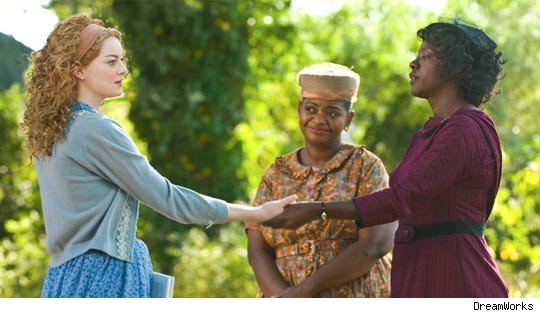
I watched The Help this past weekend. It was a wonderful film and I think it has to be the early favorite for best picture. In fact, I find it nearly unfathomable that another movie would be able to beat it. If you have not already seen it, you should drop whatever you’re doing and head to the local cinema. It’s that good.
Unlike my hipster friends, I really enjoy a film with a happy ending. The Help is full of tear-jerking moments but it has a largely triumphant ending. The good guys win and the antagonist eats s**t (literally). I personally enjoy this aspect of the movie, but I fear that the gay ending might be the most dangerous part of the film. Most people will head through the exits with a warm, fuzzy feeling–even for all the ongoing shock at how bad things were back then. In fact, most people, white or otherwise, will be rightly horrified at the injustice of the mid-twentieth-century South. Unfortunately, for many of us this just betrays our ignorance or hypocrisy–or both!
You see, most people see the civil rights movement as over and done with, another successful chapter in the story of American liberty. We can mythologize it and teach it to our children along with lessons on the Civil War. There we went again, liberating the oppressed. I suppose there is a little bit of truth to this narrative; I won’t deny that good things have, mercifully, happened in our country over time. However, this is not the whole story. Blacks are not equal in opportunity, nor under the law. And even if their standing has changed, black America is still reaping the fruit of centuries of white oppression.
Though the scenes of The Help took place nearly fifty years ago, blacks are still light years behind white Americans. The average seventeen year old white student is four years ahead of her black counterpart when it comes to education. As of 2008, one in eleven black adults (male or female) was incarcerated (compared with one in forty five whites). In addition to this sickening statistic, studies show that black men survive longer in prison than they do in freedom. Even those on the outside live radically different lives; the white median household net worth is over $113k, whereas the same rubric for blacks tops out at $5,677. The overall unemployment numbers stand right now at about 8.2% for whites and 16.8% for blacks. There are many other criteria that could be analyzed, but this is more than sufficient to make the point that there is a radical disparity between the lives that whites and blacks live.
What I’m trying to get at here is this: the civil rights movement may have ended, but that does not mean that our nation is just. The radical exploitation of blacks by whites has created a black culture that is still stumbling and trying to find its way. White Americans are sustained by the education and wealth that have built up over a number of generations, while their black counterparts are caught in a cycle of poverty that began nearly four hundred years ago. The lazy young white male ends up in some mediocre desk job, his slothful black counterpart goes on unemployment, or into prison, or to his death in the street. Yes, the brightest blacks may rise up out of this system, but many are not so fortunate.
We whites may not want to take responsibility for the sins of our forefathers, but the reality is that blacks are still suffering as a result of these sins. Those of us who name the name of Christ ought to enter into Christian repentance on behalf of these atrocities and take up service to blacks and black culture. Every church should make this mission field a priority for years to come. We need to help educate black children, employ black men and women, and rebuild black neighborhoods. Those in the broader culture may want to look at history with rose-colored glasses, but we white Christians should own up and seek forgiveness. We may think we are passionate about “the nations,” but we have little right to travel far and wide until we turn our hearts from the suburbs to the city. Take a drive through Watts (LA) or Englewood (CHI) and pray there–if you dare.
So go see The Help. Laugh. Cry. Enjoy a great film. But don’t let that warm, fuzzy feeling deceive you–the effects of slavery and discrimination are still radically evident, even if we can’t see them from behind the walls of our gated communities.


Leave a Reply