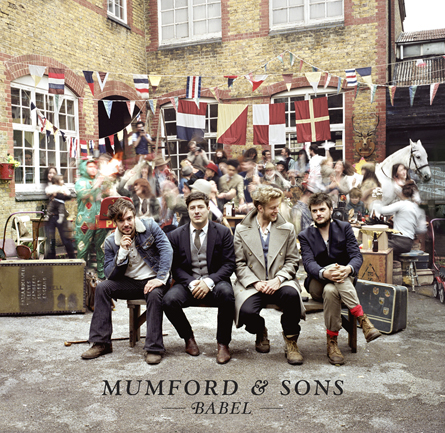
Mumford Review: Babel

Last week Mumford & Sons released their new album, Babel. It’s a great album. Not as great as Sigh no More, but I like it holistically. In many ways, this new album follows the strengths of the previous album, especially in utilizing the crescendo effect (though it is a bit predictable). The most intriguing aspect of the album is — once again — the odd association of biblical imagery alongside swear words. I’d like to start my review with that infamous song as it thematically sets up my interpretation of the album as a whole.

In the tenth track, Broken Crown, we have another Mumford & Sons song in which the F Bomb is used. If you recall my earlier post on the use of the F Bomb in P.O.D.’s most recent album, I also addressed the use of the F Bomb in Little Lion Man by Mumford & Sons. There I suggested that the use of the word was legitimate given the context. But is it the same in this instance? First of all, I just want to know, does Mumford have some sort of contractual agreement to designate one song (and only one song) to have the F Bomb in it in each album? And it’s not like they use any other swear words. It’s just the F Bomb! I just want to say that I find this kind of odd. At any rate, it’s quite clear that the F Bomb is used sparingly. And, in fact, in very similar contexts. In Little Lion Man the use of the F Bomb was intended to convey remorse and guilt, and this is even more true in Broken Crown as we’ll see. At the opening of the song, it appears that there is some sort of temptation going on. Mumford expresses his weakness and admits that his heart was flawed. It appears that whatever temptation had expired, the result was transgression. Then comes the refrain:

Crawl on my belly ’til the sun goes down.

I’ll never wear your broken crown.

I took the road and I f***ed it all away.

Now in this twilight how dare you speak of grace.

With these lines I contend that Mumford is describing the Fall of Man. “Crawl on my belly” could be a reference to the curse placed on the serpent who tempted Adam and Eve in the Garden (Gen 3.14). The rejection of the ‘broken crown’ is then most likely a dismissal of the serpent’s temptations of a rival kingdom (perhaps drawing in imagery from Jesus’ temptations), even after being consigned to the fate of the serpent (i.e. crawling on his belly). To refer to the fallen state of all humanity in this context as “I f***ed it all away” is both thematically relevant and, given the darker vibe of the song, tonally appropriate; it doesn’t feel forced. If the use of the F Bomb was appropriate in Little Lion Man, then it is so much more so in this instance. And then, to end with “Now in this twilight how dare you speak of grace” puts everything in perspective (as well as tears in the eyes). Of course, in the biblical narrative God clothes the nakedness of Adam and Eve directly after their sin (Gen 3.21). That was an extension of grace that humanity did not deserve, and Mumford’s lyrics communicate this beautifully.

The connection with the Adamic Fall of Genesis 3 is made more plausible by the additional allusions to Genesis 1-11 in the album. Taken from the biblical story about the confusion of languages in Genesis 11, the album uses the motif of languages and tongues to express the intricacies of love and relationships. Essentially, the imagery of the Tower becomes an analogy for tearing down the walls of a lover’s heart. This is made especially clear in the opening title-track, Babel, and the thematic thread is woven through the whole album. This is combined with other biblical images from the early bits of Genesis. In the second track, Whispers in the Dark, Mumford uses this imagery from Genesis 6-9 and the tale of Noah’s Ark:

Spare my sins for the ark, I was too slow to depart

I’m a cad, but I’m not a fraud, I’ve set out to serve the Lord

Additionally, the multiple references to wandering and traveling in such songs as Holland Road and Hopeless Wanderer, could possibly be allusions to the story of Cain in this broader reflection on Genesis 1-11, since Cain is consigned to wander the earth after murdering his brother (Gen 4.12: You shall be a fugitive and a wanderer on the earth). Placing the track Hopeless Wanderer directly before Broken Crown sets up the biblical imagery of that song quite well, from Cain to Adam. If indeed, the imagery of wandering is designed to have resonances with the story of Cain, then Broken Crown‘s retelling of Adam’s Fall becomes even more explicit.

In broad brush strokes, then, it seems that Mumford & Sons are allegorizing the tale of Genesis 1-11 as a way to communicate a love story. The key events and figures that are chosen — Babel, Noah, Cain, Adam — tell the biblical story in reverse order. The album is not a chapter-by-chapter interaction with the Genesis text, of course, but nevertheless a correspondence does emerge. In fact, the final song Not with Haste, with its idyllic references to green pastures, fair suns, healed scars, and lack of sadness, appears to reflect on the original state of creation in Genesis 1. Perhaps there is an intuition here that is designed to point forward to the end of Revelation in chapters 21-22. Speaking canonically, when we tell the biblical story in reverse order from Genesis 11 and the Tower of Babel on through to Genesis 1 and the creation of the cosmos, what comes next? Well it’s Rev 21-22. Of course, the end of Revelation is designed to replicate the imagery of Genesis 1 and so returning to the “Garden” in the final track of Mumford’s album explains why this song carries an eschatological ring to it — “They’ll heal our scars. Sadness will be far away.” Thus, I suggest that Not with Haste contains a conflation of Genesis 1 and Rev 21-22. This I contend is the framework of Babel; it is a tale of love utilizing the matrix of Genesis 1-11. Though it provides more of the structure to the album than an interpretive key; the biblical imagery is clearly not the main aim of the album and the parallels are a tad loose.

This review has primarily focused on the broader aspects of the album. I could of course try to describe the sound and vibe of each song, but you’d have a better experience listening to it yourself. Babel is an album that gets better with each listen, but it admittedly feels more generic than their previous effort. I find the track Broken Crown incredibly moving, but this is in fact a noticeable exception. The lyrics of the album as a whole feel like they should have spent a little more time in the oven. By way of contrast, the lyrics on Sigh No More were so gripping to me, but this just isn’t the case with Babel. Sadly, I think the tongue that was confused here was Mumford’s.

John Anthony Dunne

You might also enjoy…

15 responses to “Mumford Review: Babel”

  1. Matt

    John,

    Well-written as usual. I wonder, though, whether your interpretation is not far, far too theological. Though you’re certainly right to spot biblical themes, Marcus Mumford & co. have made it very clear that they are not Christian artists. In a recent interview, Marcus even said that he does not call himself a Christian; of course this too needs interpretation. He also intimated that the “Broken Crown” song is a painful narrative about someone and something in his own life (although he clearly echoes themes from the fall).

    Having listened to the album a dozen times or so now, it seems to me much more a collection of personal tales tied together loosely by some ambiguous spiritual themes. The song-writer is clearly reflecting on things with an inherited stock of biblical language and even some “Christian-ese”, but I don’t think we can see it as a biblical meditation–especially not an “allegorizing” of Gen 1-11. That would read into the text of the album and go against the specific statements of its author.

    At least that’s my take–what do you think?

    1. John Anthony Dunne

      Thanks Matt, like I said I don’t think the imagery from Gen 1-11 is the interpretive key. Rather I think it provides structure. I think the explicit Babel imagery invites this sort of reflection. The biblical imagery from Gen 1-11 is there throughout the album and I do think its possible that he is utilizing the imagery for his purposes. Again, as I said, it is not a direct one-to-one correspondence. The biblical imagery is painted with “broad brush strokes” as I mentioned.

      1. John Anthony Dunne

        And, to be clear, by saying all of this, I’m not suggesting that the music is “Christian.” I don’t quite appreciate that label for music as I’ve written on this blog a few times before.

        1. Matt

          I guess I just mistook your drawing so many connections with an implicit assertion of something akin to “authorial intent”–I stand corrected!

  2. I have to be completely honest. This album is really lame. They’re a great band. Great musicians. But they seem to just cycle song types and stay content where they are at. no growth whatsoever.

  3. Well this is a good reminder that I need to pick up the album. It is fascinating how Spiritual their themes are. I remember an old interview saying they invoked spiritual themes because they transcend time. In other words, people will still be interested in them in 100 years, but may not care as much about a suped up mercedes or something.

    If nothing less, the success of Mumford shows our society’s craving for something real and deep. They just don’t know where to get it.

  4. Interesting article, though I haven’t really heard of Mumford. I’m from a previous generation, musically speaking. But it reminded me of one of the most hilarious movie moments I’ve had watching a Christian movie where a supposed gangster said something to the effect of:

    “you jelly belly, good for nuthin’ mama’s boy!”

    It was hilarious. No gangster speaks that way! Wouldn’t it be better for Christian movies to portray realistically the actual situation in the world? Ala City of God or Boyz n the Hood? If they are going to portray gangsters?

    I have a friend who produces Christian movies where the cheesy dialogue is conscientiously intentional. The reason? Mostly economical. The people who finance such ventures wouldn’t approve of a script with “swear words” in them if they are targeting a Christian audience. Is that why Mumford is distancing himself from the “Christian” label? But I can’t help but feel this contributes to a shallow and superficial sense of Christian aesthetics. And perhaps to unrealistic expectations of living in a sinful, broken world.

    Why not make a rated R Christian movie?

  5. pj

    There is a rated-R christian Movie, its called Passion of the Christ. And Peter even cusses with the “D” word in it 🙂

  6. Jay

    Your concerns about this album is precisely the thing that makes it GREAT. The world is SO TIRED of NED FLANDERS and his “don’t say anything off color okaly dokaly” churchy churchy bullshit, but yet many people still see immense value in scripture and Christianity, just not the “nice guy” nonsense that goes with it.

    Away with your Neddy fundamentalism and “don’t ever say ‘fuck’” nonsense, and let’s get real.

    1. John Anthony Dunne

      Apparently somebody didn’t read my review very carefully…

      1. Jay

        Well, it looks like I owe you an apology.

        I did in fact skim over your review, not reading most of it, and when I saw the “contractual agreement” to use the f bomb part, I was irked (and to be honest I was having a pretty bad day), and misunderstanding, I left that comment, and for that I apologize. I come from a religious background myself, and even though there were many great things about it, I have been burnt by the “nice guy” culture. And so my irksomeness combined with my skimming over, and produced that comment. Sorry about that… :-/

        Looking at your review now in it’s entirety, let me say a few things on top of my apology, (but after actually reading your review and understanding it).

        I can say that I actual really appreciate what you’re saying, as it is indeed thematically what I love about them. I appreciate you pointing out the allegorizing of Genesis 1-11, as that is indeed what they are doing. Knowing that Marcus Mumford himself comes from what I would now call a “fundamentalist” Christian background (his parents lead the Vineyard movement in the UK), this album is indeed so beautiful because he is honestly wrestling with his faith (rightfully I think), seeing the value in Christianity, but (rightfully) questioning the literalism that is so rampant everywhere.

        And so the whole album is indeed a “walk-thru” of the Bible metaphorically (and it’s refreshing to see someone point that out), but (and this is where I’d thematically part company with your review), it is not an antagonism-free journey. I would suggest to you that Mumford is not painting a picture of the Bible solely as a celebration or appreciation of it (although that’s certainly there), he is also doing something far more heretical…

        And I believe the key to understand that heresy is in the song “Whispers in the Dark” (which has been my personal theme song ever since I first got the album the day it came out).

        In that song, although he is in know way renouncing Christianity in general, it is a story of him rejecting his “literalism” and fundamentalism.

        But even more deeply than that, I believe he is questioning the fundamental “judgement” from God that condemns men as “evil” by the banishment from the garden of Eden for “eating of the fruit”. He is in fact challenging the banishment from Eden (although simultaneously appreciating the Bible and his religious background, which is what makes it so amazing, and partly why it resonates so deeply with millions).

        Consider the lyrics even more deeply:

        “This cup of yours tastes holy,
        but a brush with the devil can clear your mind,
        and strengthen your spine.”

        I believe, that along with other bands as well (notably 30 Seconds to Mars in “this is war”), Mumford is saying, “Yeah, I appreciate your holiness and commitment to your faith, but there has to be an understanding and appreciation of ‘the devil’ as well (the dark side of man, not an actual entity). The “devil” has indeed served a purpose, I believe he is saying, and we just need to understand “him”, and then the evil will end (as you point out in “Not with Haste”, although peace is achieved for the opposite reason you presume).

        He says “Fingers tap into what you were once, and I’m worried that I blew my only chance”.

        I believe he’s talking about when he was younger and more zealous (and more naive), and he’s worried he won’t find that “aliveness” he knew in ignorance, now that he has tasted of “good and evil”.

        And then, like all Mumford’s songs, he switches immediately to his personal life, describing an “affair” or some sort of relationship:

        “steal a kiss and you’ll break apart, pick up your clothes and curl your toes, learn your lesson, lead me home.”

        And then he switches back to the broader issue (as you mention): “I’m a cad, but I’m not a fraud. I had set out to serve the Lord”, basically saying although he cannot side with the literalism that he was raised in, and the “judgement of man” as “evil”, he still nonetheless was authentic in his motivations.

        I love this album so much because I too believe that biblical literalism, fundamentalism, creationism, etc have all been displaced by science and our expanding view of our universe (of which we are now provably NOT the center), but yet I so very much love the Bible and Christ and appreciate my background which got me to this point. But I too believe that man’s dark side must just be understood, instead of condemned as evil. This quote sums it up for me: “There could be no new Jerusalem without leaving the infancy of Eden.” (and just as a side point, in the Genesis story, there is no place where God explicitly calls man “evil”).

        It’s so easy these days to be either a secular or a religious fundamentalist, and Mumford is so great precisely because they are neither (and that subconsciously comes through along with the music that so beautifully carries it), and they are looking forward to a time where everything can be united, and by understanding the dark side of man, we may be able to take the next step.

        Forgive me for getting upset and writing what I did, not actually reading your review. But I would still even suggest that this album runs far deeper than you even know (although you understand it WAY more than the average person, and I really appreciate that).

        Lately I have come across a scientific understanding of our “condition” as humans that, I think, actually reconciles science and religion (with a profound appreciation for both). It has just been really hard for me, because I have had to shake off so much “fundamentalism baggage” (“shake the excess” :-P). I will share the link with you if you would like.

        But Mumford’s music has taken care of my soul during this whole process (and that’s partly why I’m so passionate about them).

        Defying the literalism that is everywhere while still trying to hold onto an appreciation of the Bible and Christianity as a beautiful force, is a line that virtually no one walks, and that’s why I love them so much.

        Anyway, if you made it this far, thanks for reading. And sorry for that ignorant comment 🙂

        -Jay

        1. John Anthony Dunne

          Jay, thanks for the apology (accepted) and the comment (interesting). I would make no claim to have an exhaustive understanding of everything about Mumford as a whole or the album in particular. I simply wrote down a few themes that I noticed, and by noting them I wasn’t even suggesting that these things were the most important features of the album (thematically or otherwise).

  7. […] See this review for a great analysis of how Christian themes and imagery are weaved throughout Mumford and Sons music, as well as a contextual look at their sparing, yet unfortunate use of expletives. […]

  8. Noyfb

    Unreal … 1st of all … Mumford and Sons WAS a good idea when they 1st released .. and as some (even on this page of nonsense) have suggested — they aren’t that good. “No growth” sums it up nicely. Also, religion is just that- religion and in my eyes and LOTS of others … nonsense and fairy-tales. The Bible as it stands has many great references on how to live your life- but take it as that and leave the rest of the BS where it belongs … in the GD past … now … back to listening to my music … f**king mountains our of molehills … ffs … smh

Leave a Reply to Joe Donaldson Cancel reply

Your email address will not be published. Required fields are marked *