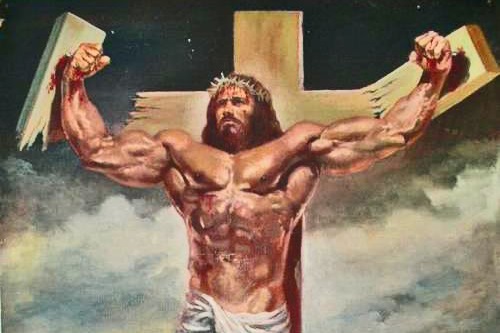
The Macho Version of Biblical MANhood

So far on this blog we’ve had some discussion led by Ryan about how the biblical manhood movement (mis)uses statistical cultural analysis when applying it to the Church (For the relevant posts in the 6-part series: #1, #2, #3, #4, #5, #6).  I do not intend here to pick up the discussion further, or to write multiple posts on the topic of Complementarianism vs. Egalitarianism.  Rather I am concerned with the way Christians talk about manhood.  Hoping to avoid generalization, I will say up front that this critique does not apply to everyone in the biblical manhood movement.  However, I do intend to express some concerns.  It appears to me that in an effort to avoid allowing the egalitarian shift in culture to influence how the Bible is interpreted, some Christians have done a bit of their own cultural imposition; namely, by beginning their quest for understanding manhood as taught in the Bible with a culturally defined understanding of what it means to be a man.  Thus, it is an essential issue of prolegomena to define what it means to be a man before ever addressing the biblical witness about the roles of men and women in marriage and the Church.  For this post I am only concerned with prolegomena, and I will be more concerned with what manhood isn’t than with what it is.

Of course, how we conceive of manhood has implications for what he think about Jesus.  From the main picture of this post it is obvious that some Christians have come to conceive of Jesus Christ as manly or macho (note the words at the bottom: “Bench Press This”), since they assume that a ‘real man’ likes certain things (e.g. working out) and dislikes other things (e.g. musicals).  There are expressions of this in various stripes.  One pastor from the Southern United States was recorded preaching a hilarious sermon on why Jesus wore pants instead a dress!  Besides the silliness of the cultural ignorance and historical anachronism regarding the relationship between manhood and pants-wearing, the most extreme statement that I’ve come across in regards to importing modern conceptions of MANhood onto Jesus come from pastor Mark Driscoll. Note his words from Relevant Magazine:

There is a strong drift toward the hard theological left.  Some emergent types [want] to recast Jesus as a limp-wrist hippie in a dress with a lot of product in His hair, who drank decaf and made pithy Zen statements about life while shopping for the perfect pair of shoes.  In Revelation, Jesus is a pride fighter with a tattoo down His leg, a sword in His hand and the commitment to make someone bleed.  That is a guy I can worship.  I cannot worship the hippie, diaper, halo Christ because I cannot worship a guy I can beat up.  I fear some are becoming more cultural than Christian, and without a big Jesus who has authority and hates sin as revealed in the Bible, we will have less and less Christians, and more and more confused, spiritually self-righteous blogger critics of Christianity.

To be fair, Driscoll has good intentions with this quote, and some of it should be salvaged (primarily the last sentence).  But there is an incredibly problematic idea at work here.  The idea is this: since Jesus was a man, he was a MAN.  There is admittedly an opposite tendency in some artistic renditions of Jesus which focus on his meekness (perpetuated by the way we talk about ‘baby Jesus’).  Yet it is unfathomable to suggest, as Driscoll does here, that worship of Jesus is contingent upon whether or not one would be able to beat him up.  Frankly, Jesus was beat up.  Our Christian faith is based upon a proclamation which is centrally focused on the death of our God.  Jesus was the man of sorrows; likened unto someone that people would hide their faces from (Isa 53.3).  We often respect and (for the ladies) are attracted to men who are tall, strong, have a full head of hair, straight white teeth, etc.  But Jesus was a 1st century Jew, so isn’t it likely that he was short?  Since the ability to maintain good hygiene wasn’t as available as it is now do we assume that he was always healthy?  What if Jesus’ teeth weren’t white, or worse, what if some were missing?  As a carpenter, do we suppose that he was particularly buff?  Now, the point of these questions is not to reconstruct the historical Jesus, but rather to remind us that we do not worship Jesus as the Son of God because he was a MAN, but because he emptied himself to become a man.

Therefore, when attempting to address what the Bible says about manhood, let us avoid importing categories from modern culture.  There are no two males that are exactly the same; we have various preferences for all sorts of things.  I believe that it is in fact damaging to perpetuate the cultural myth that manhood equals MANhood.  If this persists it will undoubtedly create identity and personality crises among male members of the Church.  Thus, our view of manhood must not be so rigidly defined.  Though it may seem counter-intuitive, manhood must be flexible enough to include Paul’s theology of weakness (2 Cor 4.7-12; 6.1-10; 11.16-29; 12.9-10), and fluid enough to incorporate maternal images of leadership, protection and care (Gal 4.19; 1 Thess 2.7-8); which is also part of God’s self-revelation of himself (Num 11.12; Deut 32.18; Ps 131.2; Job 38.8, 29; Prov 8.22-25; Isa 42.13-17; 45.9-11; 46.3-4; 49.14-18; 66.12-14; Hos 11.1-3; Mt 23.27; Lk 15.8-10; 1 Pet 2.2-3).


John Anthony Dunne

You might also enjoy…

22 responses to “The Macho Version of Biblical MANhood”

  1. Isai Garcia

    Excellent post! For a while, I have been weary of this type of machismo. It has been very attractive for many men. I read an article online about the old “Green Ranger” from Power Rangers. He is a Christian guy, that fights in MMA matches. On his trunks, he has written out, “Jesus didn’t tap” (or something to that effect). This misses the point biblically, but does represent the neo-reformed, buff, martial art superstar Jesus pretty well.

    1. John Anthony Dunne

      Isai thanks for your comment. I wasn’t aware that the Green Ranger was a Christian MMA fighter. The line “Jesus didn’t tap” is very similar to the Lord’s Gym image I included for this post. Its certainly a pervasive trend, in evangelicalism at least, to go in this direction. For me it simply gets right against our confession of Chalcedon. What does it mean for Jesus to be fully man? Does that mean he’s a “pride fighter” or a NFL fan? It really is quite sad to see Jesus’ humanity get hijacked into huMANity.

  2. I always think of this specific video of Driscoll when I think of this conversation:
    http://www.youtube.com/watch?v=ZkaeAkJO0w8

    It’s a very strange “sermon” which goes from talking about men who seem to be somewhat abusive, to Driscoll yelling and screaming at men to put on their pants and get a job, to becoming a member at the church, to a tithe collection. The whole thing is a little bizarre (though I think Driscoll in general is a bit bizarre), but I think my main beef with this video and the manly men trend happening is that it is really inconsistent. Are we trying to encourage men to not be abusive, get jobs, or wear pants (as you have said, JD)? And why must we be yelling and using some borderline provocative language? All I want to do is just yell at Driscoll after seeing this video because how else do you respond to that interaction. Does this mean fathers should yell at their sons in this manner? I’d say no. I also do not appreciate this movement giving such a hard time to men who are unemployed and subsequently depressed (many times). Even coming from a complementarian viewpoint, I don’t think it’s unbiblical for the wife to support the husband in times of need. How can we expect men to be 100% perfect through a life which tends to be more difficult than not. I think there are seasons for men that can be filled with rest and rejuvenation. Some might disagree but I hold firm to that.

    Anyway, thanks John for bringing light to this issue in a different way because I am definitely attracted to men not because of their manliness but because of their godliness. And I am just not sure that the images of godly men are lining up with these images of manliness being preached today. Christ humbled himself to death… he was “beat up”… is this the God that Driscoll doesn’t want to worship?

    1. Kevin O’Farrell

      pretty unfair representation of the “how dare you” message and what driscoll was saying.

      if you can’t yell at grievous sin where men are abusing their women and refusing to commit to the church in a real way while avoiding general life responsibility–then i don’t know what we can ever yell at. Jesus yelled when he saw grievous sin (Mt. 23).

      1. I think we will just have to agree to disagree on this one.

        1. Kevin O’Farrell

          touché

    2. John Anthony Dunne

      Carrie, thanks for the link. I’m not as upset about this video as you are. To be honest, I like Driscoll. I think he says things sometimes that are problematic, but I don’t have a vendetta against him and I appreciate his passion. But you may be right about the over-emphasis on getting a job and all that. It does seem to imagine that women can’t do some of that themselves. If the issue is that one cannot get a job that is totally different than someone being too lazy to get one, however.

      I do appreciate your final paragraph though. The issue should be godliness not manliness! And as my last sentence pointed out, godliness can have some maternal characteristics!

  3. Mike Bird

    Ha, I used to have that poster in my bedroom!

    1. John Anthony Dunne

      Did you really? Please tell me it was simply a joke! : )

  4. Dustin Arnold

    John, I think you’re right on the money with this. I was talking with a classmate of mine about this topic and Driscoll’s influence on Christian culture at large in this arena. I do appreciate his goal of trying to motivate men towards action and leadership, but I think he paints a terribly false picture of manliness. It seems like the big issue is pointing only to specific outward actions rather than the character & spiritual issues behind them. The irony is that I think his “counter-cultural” perspective on masculinity is actually very culturally (and personally) influenced.

    It also seems like a lot of it comes down to isolating particular modes of Jesus’ behavior and generalizing that to his entirety; Driscoll being the opposite end of the spectrum of “Jesus is my homeboy.” I think Mark’s Jesus ignores huge aspects of Christ’s character, just the opposite traits that the people he’s targeting do.

    1. John Anthony Dunne

      Dustin, thanks for your comment. I especially like the last line of your first paragraph. It is quite culturally-bound indeed! And with the second paragraph, you’re right, there’s a spectrum to how we view Jesus (throw in the baby Jesus prayers in Talladega Nights), and this depends on what parts of Jesus’ life and ministry we choose to emphasize. Jesus is quite diverse.

    2. John Anthony Dunne

      I’d like to get some of your thoughts on this issue from a psychological perspective, especially regarding implications for the Church. I referenced the fact that I think an over-emphasis on manliness can create identity crises for some males, and I imagine you’d have better things to say on that specifically.

      1. Dustin Arnold

        Definitely! This whole topic is really interesting to me. I actually met with a professor last week and I may be doing my dissertation on Male Identity Development. Maybe we can talk about it over something by Russian River next time you’re back in town 😉

        I really wonder how firmly Mark holds these ideas of what it is to be a man. Because I’d be really curious how he reconciles that with the life of Jesus. It’s hard/impossible to imagine his Jesus weeping at Lazarus’ death or using children as an example for knowing/trusting God, or even being relational to people.

        1. John Anthony Dunne

          No way! I had no idea that you’ll be a future expert on the topic! We should definitely chat about this more. And yes, an RR brew is a must! Actually, I’ll be back at Biola for Dec 13-14 and maybe even the 15th so we should plan a big Bottle Room trip : )

        2. John Anthony Dunne

          Also, anytime you want to write for us here at the two cities just do it! We could use some good psychological perspective on here.

          1. Dustin Arnold

            Yeah, it’s a longtime interest of mine that I’ve been getting a lot more serious about lately. I was really excited to find a professor interested in working with me/supervising me on that since there’s currently nothing being written/researched on it at Rosemead.

            And thanks for the offer! If I ever have something I think might be interesting and a good fit for the blog I’ll let you know.

  5. […] The Macho Version of Biblical MANhood […]

  6. […] part, our posts have been critical of various strands within the Biblical Manhood movement (see my post where I critique the over-emphasis on “manliness“; cf. Ryan’s 6 part critique of the use of sociological data by Driscoll and Mohler: […]

  7. I plan on getting the lords gym tattoo that says lords gym sin of the world gym bench press this! I got the shirt and since then always wanted the tattoo

  8. […] “…There is a strong drift toward the hard theological left.  Some emergent types [want] to recast Jesus as a limp-wrist hippie in a dress with a lot of product in His hair, who drank decaf and made pithy Zen statements about life while shopping for the perfect pair of shoes.  In Revelation, Jesus is a pride fighter with a tattoo down His leg, a sword in His hand and the commitment to make someone bleed.  That is a guy I can worship.  I cannot worship the hippie, diaper, halo Christ because I cannot worship a guy I can beat up.  I fear some are becoming more cultural than Christian, and without a big Jesus who has authority and hates sin as revealed in the Bible, we will have less and less Christians, and more and more confused, spiritually self-righteous blogger critics of Christianity….” […]

  9. […] “…There is a strong drift toward the hard theological left.  Some emergent types [want] to recast Jesus as a limp-wrist hippie in a dress with a lot of product in His hair, who drank decaf and made pithy Zen statements about life while shopping for the perfect pair of shoes.  In Revelation, Jesus is a pride fighter with a tattoo down His leg, a sword in His hand and the commitment to make someone bleed.  That is a guy I can worship.  I cannot worship the hippie, diaper, halo Christ because I cannot worship a guy I can beat up.  I fear some are becoming more cultural than Christian, and without a big Jesus who has authority and hates sin as revealed in the Bible, we will have less and less Christians, and more and more confused, spiritually self-righteous blogger critics of Christianity….” […]

Leave a Reply

Your email address will not be published. Required fields are marked *