
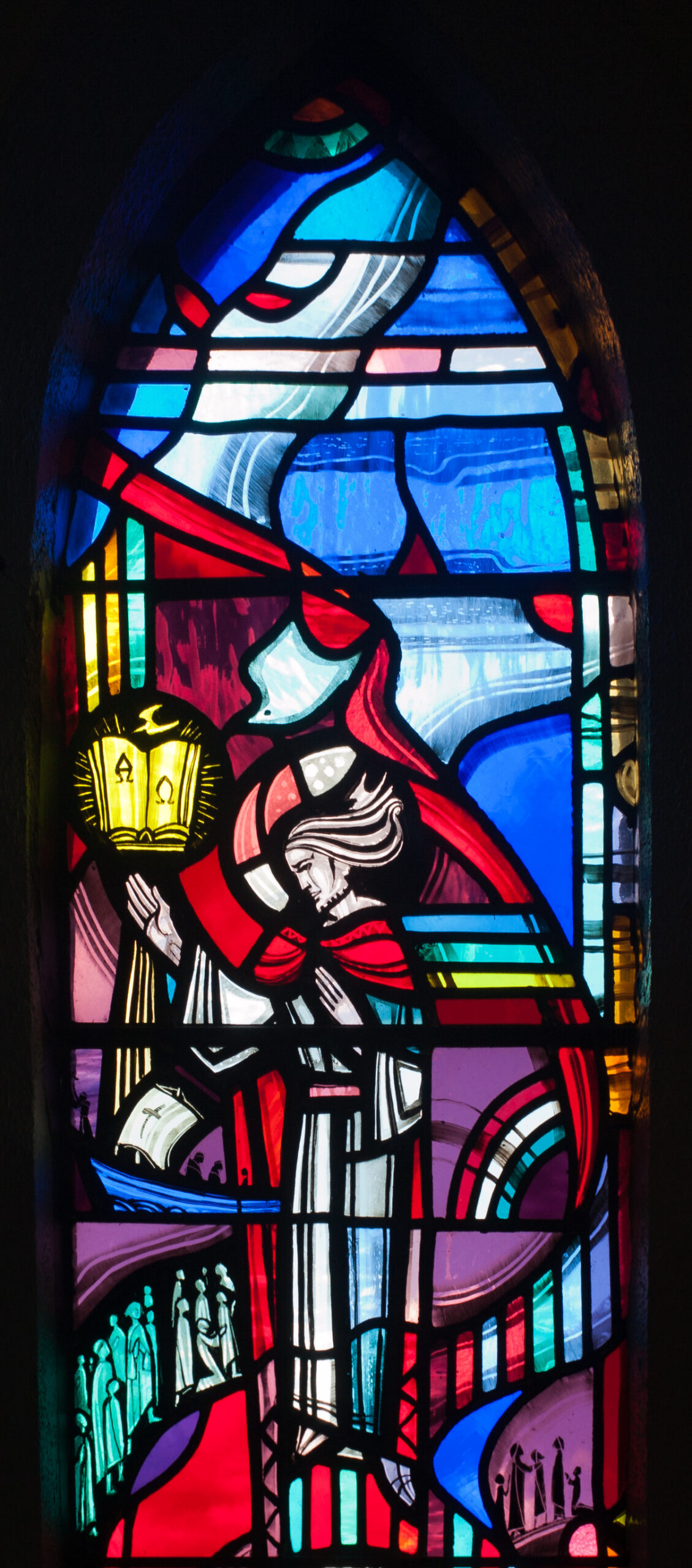
Photo credit: “Tullow Church of the Most Holy Rosary South Transept Window Mysteries of Light and Pope John Paul II Detail Proclamation of the Kingdom of God 2013 09 06” by Andreas F. Borchert is licensed under CC BY-SA 4.0.
We read in Col. 1:13 (ESV) that the entrance of believers into the Kingdom of God begins in this life, not the next: “He has delivered us from the domain of darkness and transferred us to the kingdom of his beloved Son.” The underlying Greek text reads: ὃς ἐρρύσατο ἡμᾶς ἐκ τῆς ἐξουσίας τοῦ σκότους καὶ μετέστησεν εἰς τὴν βασιλείαν τοῦ υἱοῦ τῆς ἀγάπης αὐτοῦ. The key verb here is μετέστησεν, which is in the aorist tense and means “to remove” or “to transfer.” Scholars refer to this general phenomenon of our earthly entrance into God’s Kingdom as “inaugurated eschatology;” that is, the “end times” began with Jesus’ first coming, but will only be fully completed at his return. It is often summarized as the “already, but not yet” of God’s Kingdom.
We encounter a brief scriptural description of this process of entering God’s Kingdom while we are in this world, that is, in the here and now, in 1 Cor. 15:53 (ESV): “For this perishable body must put on the imperishable, and this mortal body must put on immortality.” We read another description of this transformation from a different perspective in Acts 14:22 (ESV): “through many tribulations we must enter the kingdom of God.” Underlying both these verses we find similar Greek language for the modal expression “must;” namely, the Greek verb δεῖ plus the aorist infinitive of the relevant action verb. In 1 Cor. 15:53 we read: δεῖ γὰρ τὸ φθαρτὸν τοῦτο ἐνδύσασθαι ἀφθαρσίαν καὶ τὸ θνητὸν τοῦτο ἐνδύσασθαι ἀθανασίαν. Acts 14:22 provides: διὰ πολλῶν θλίψεων δεῖ ἡμᾶς εἰσελθεῖν εἰς τὴν βασιλείαν τοῦ θεοῦ. If there is any doubt that both these passages refer to transformation into God’s Kingdom as a gradual process beginning in our earthly lives, we need only cite 2 Cor. 3:18 (ESV): “And we all, with unveiled face, beholding the glory of the Lord, are being transformed into the same image from one degree of glory to another. For this comes from the Lord who is the Spirit.”
In both these passages, 1 Cor. 15:53 and Acts 14:22, we see that the Greek construct of δεῖ plus an aorist infinitive refers to a present, ongoing process, a process of transformation that begins, though it does not end, in this life. This is notable since of the 63 or so instances where a similar construction appears in the NT of δεῖ falling near a related infinitive, especially where the accompanying infinitive is in the aorist rather than in the present tense, the majority seem to indicate a future event or state, rather than an ongoing process; for example, Matt 16:21, Matt 17:10, Mark 13:7, Luke 12:12, and perhaps Col 4:4 and Eph. 6:20. Examples to the contrary would include Luke 15:32 and Matt. 23:23.
We now have before us two descriptions of this transformation of believers into the Kingdom of God—putting on immortality and incorruptibility (1 Cor. 15:53), and undergoing suffering (Acts 14:22). But how does this complicated process of transformation happen, a process that is no doubt unique to each believer and their individual circumstances? In other words, what is the mechanism by which this process of entering God’s Kingdom occurs? What is the driving force behind each believer’s transformation from the earthly to the eternal? What brings it about? In short, what are the scriptural “nuts and bolts” that inform us as to how this all actually takes place?
Interestingly enough, for the answer we must once more encounter another passage featuring an underlying δεῖ plus an aorist infinitive syntactical pattern; namely, 2 Cor. 5:10, where the main clause reads (ESV): For we must all appear before the judgment seat of Christ.” The underlying Greek text provides: τοὺς γὰρ πάντας ἡμᾶς φανερωθῆναι δεῖ ἔμπροσθεν τοῦ βήματος τοῦ Χριστοῦ. So far, so good, but here is where the translation becomes tricky. The conventional view of the following subordinate clause goes something like this (ESV once again): “so that each one may receive what is due for what he has done in the body, whether good or evil.” With all due respect to the scholarly community, this represents an outdated reading of the Greek grammar. The proper rendering of the subordinate clause would go something like this: “so that each of us may receive in our bodies what is due us for what we have done, whether good or bad.”
In other words, believers undergo their final judgment in this life, not in the next. Christ’s Judgment Seat is therefore not an apocalyptic venue that takes place in some vague future, but it is a present, ongoing reality, a concrete give-and-take if you will, between Jesus and each individual believer, a judgment that is received in our physical bodies here on earth as Jesus mercifully prepares us for eternity. To read more about why this is so, please go to THE TEAM link across the top of this blog, scroll all the way down to the bottom of the page, find the name Tom Peters in the list of contributors, click on it, and you will find a slew of articles on the subject, any one of which should point you in the right direction.
The upshot of all this is that Christ, through his Judgment Seat, personally guides, directs, and ushers believers individually, one-by-one, into his Kingdom as he interacts with them in this life amid their unique circumstances, whether they are consciously aware of that interaction or not. Everything that needs to be done before we fully enter into eternity, be it sanctification, purification, suffering, gradually putting on our new spiritual bodies, the sacraments, or anything else necessary for our full transformation into heavenly glory, it is all accomplished with Christ’s direct supervision and guidance as we live out our lives here on earth. While this is truly good news, should it really come as a surprise though? Does anyone believer that we could pull this off on our own? That is why judgment for the believer should be regarded as a joyful experience, despite perhaps some temporary discomfort, or worse, from time to time, which we are warned about in scripture. For a discussion of the temporary distress that sometimes accompanies this process of transformation, we read in 2 Cor. 4:17 (ESV): “For this light momentary affliction is preparing for us an eternal weight of glory beyond all comparison;” and Hebrews 12:11 (ESV): “For the moment all discipline seems painful rather than pleasant, but later it yields the peaceful fruit of righteousness to those who have been trained by it.”
To quote Professor N.T. Wright in his book Surprised by Hope (Harper One, 2008), 137: “We need to remind ourselves that throughout the Bible, not least in the Psalms, God’s coming judgment is a good thing, something to be celebrated, longed for, yearned over. It causes people to shout for joy and the trees of the field to clap their hands.” For further scriptural support, we read in Isaiah 55:12 (NIV): “You will go out in joy and be led forth in peace; the mountains and hills will burst into song before you, and all the trees of the field will clap their hands;” and in Psalm 98:8 (NIV): “Let the rivers clap their hands, let the mountains sing together for joy.”
Upon the death of the believer, as the result of Christ’s interaction with them through his Judgment Seat during their earthly lives, he or she is fully prepared for Christ to consummate their salvation and heavenly transformation by raising them up in their new eternal bodies, thereby turning the “inaugurated eschatology” brought about by Christ’s earthly ministry and sacrifice on the Cross into the “final eschatology” for all time. No further comprehensive, evaluative judgment of believers is necessary. That is reserved for non-believers who by definition have rejected Christ and any need for a savior and have instead chosen to be judged on their own merits. For them The Great White Throne outlined in Rev. 20:11-15 awaits.


Leave a Reply to Thomas Peters Cancel reply