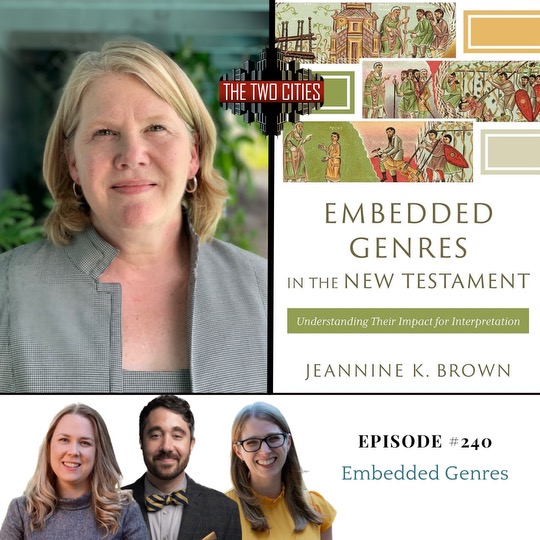
Embedded Genres with Professor Jeannine Brown (Podcast)

In this episode we’re joined by Professor Jeannine Brown, who is David Price Professor of Biblical Foundations at Bethel Seminary, a member of the NIV translation committee, and the author of a number of books on Hermeneutics and the Gospels as well as the book that we’re excited to discuss in this episode, Embedded Genres in the New Testament: Understanding Their Impact for Interpretation (published by Baker). In our conversation we talk about the interpretative difference it makes to recognize how discrete genres appear within other broader genres (such as poetry within letters, riddles within Gospels, etc.), and how the embeddedness itself creates an interplay where both the broader genre and the embedded genre take on fresh characteristics as a result. Team members on the episode from The Two Cities include: Dr. John Anthony Dunne, Dr. Madison Pierce, and Dr. Sydney Tooth.

You can find this new episode on SpotifyApple PodcastsGoogle PodcastsOvercastBreakerAnchor, or wherever you get your podcasts. Check it out, subscribe for weekly episodes every Wednesday, and please give us a rating and review!

John Anthony Dunne

You might also enjoy…

One response to “Embedded Genres with Professor Jeannine Brown (Podcast)”

  1. Tom Peters
    Tom Peters

    I just listened to the fascinating discussion of embedded genres in your podcast with Dr. Jeannine Brown over her new book, Embedded Genres in the New Testament: Understanding Their Impact for Interpretation (Baker), a great book by the way. I would like to raise the same issue that I put to Dr. Judd over his new book on genre. It concerns a recent post I made to this blog, which you can find here, where I analyzed 2 Cor. 5:10 (Judgment Seat of Christ) as a divinely embedded genre, in this case the genre of a riddle. Is there, do you think, such a thing as a divinely embedded riddle genre in scripture, and how should such a thing be approached in analyzing the text? Many of the purely “human” factors, such as social setting and ancient oral traditions, generally involved in genre analysis might not be in play here, or are they?

    Dr. Judd posted this response to my inquiry: “I had a read of your post regarding 2 Cor and I think the idea of a riddle is fascinating. I don’t know enough about it to comment whether it’s likely a human or divine embedded genre.”

    The proposed riddle here is embedded within an apocalyptic or eschatological discourse (2 Cor. 4:16- 5:10), and each of those two genres would certainly inform the other. The riddle, with its eschatological context, would explain to modern readers the whole notion of divine judgment of believers. Interestingly, this would lead to an outcome at odds with the overwhelming majority reading of 2 Cor. 5:10. (My article analyzing the formal, that is, the grammar and syntax, and the conceptual issues underlying this passage, along with the much shorter introduction and postscript outlining the high doctrinal stakes involved in this question, can be found under the Biblical Studies link of this blog.)

    Could this embedded riddle have remained “opaque” until now when its intended audience might be more receptive to its message? With a humanly placed embedded genre, even with a writer as perceptive and inspired as Paul, that would be doubtful, but with a divinely embedded riddle, such a possibility becomes quite possible, perhaps even expected.

    Thanks again, Dr. Brown, for all your wonderful scholarship in this area.

Leave a Reply to Tom Peters Cancel reply

Your email address will not be published. Required fields are marked *