
Disclaimer time: the views expressed here do not represent you know, whoever disagrees with them.
Oliver O’Donovan’s The Desire of Nations is a difficult but spectacular book that seeks to ‘rediscover the roots of political theology’. It is essentially a long theological exposition of the concept of authority in the Bible, with a focus on the way in which earthly authorities are both established and relativized by the advent of God’s authority in Jesus. I highly recommend it. O’Donovan is at his best as he draws together and applies concepts toward the end of the book. His discussion of the biblical concept of liberty vis-à-vis that of modern liberalism is especially insightful. (Note: ‘liberalism’ refers to all Western, democratic political structures since the Enlightenment. Both Republicans and Democrats are liberals in this sense.)
Summing up the biblical notion of freedom, O’Donovan says:
We discover we are free when we are commanded by that authority which commands us according to the law of our being, disclosing the secrets of the heart. There is no freedom except when what we are, and do, corresponds to what has been given us to be and to do. …We must receive ourselves from outside ourselves, addressed by a summons which evokes that correspondence of existence to being. ‘Where the Spirit of the Lord is, there is liberty’ (2 Cor. 3:18). (252)
This is, of course, in contrast to the two variations of ‘freedom’ on offer in modern political discourse, the negative as ‘freedom from control’, and the positive as ‘freedom for self-realisation.’ ‘The one consists in the abolition of oppressive constraints, the other in opportunities which are somehow given as a birthright; the one lacks an end beyond the goal of liberation itself, the other needs liberation to bring its end within reach’ (255). These both get at things that are essential to the theological definition of freedom stated above, but as it stands they both have one fatal flaw: they are predicated on an individualistic ontology. As such, they are always at odds and never in concert. One can see this in our current political dialogue.
Much of the current ‘conservative’ political agenda is polemically cast as advancing ‘freedom from control’: we do not want big government, more taxes, or more regulations. Why? Because it is these things that will stymie our ‘freedom for self-realisation’—let us invest our money, use our resources, and realize our potential. The ‘liberal’ agenda, on the other hand, wants to provide ‘freedom for self-realisation’: they want everyone to have meaningful jobs, the opportunity to buy things, and protection from others who would infringe upon these rights. So the means to secure ‘freedom for self-realisation’ for the ‘liberal’ is likewise to secure ‘freedom from control’. In the end, your ‘freedom for self-realisation’ always intrudes upon my ‘freedom from control’. What matters to me is me and what matters to you is you. Thus it is individualistic conceptions of freedom that ultimately lead to the partisan nature of our politics.
(A partisan note: by my judgment, one of the developments of the last couple of decades is the ‘conservative’ radicalization that posits two absolute axioms. First, the idea that their ‘freedom from control’ will not at all intrude upon others ‘freedom for self-realisation’. Second, they insist that it is actually their ‘freedom for self-realisation’ that will ultimately secure the same freedom for others (e.g., business owners are not controllers of wealth, they are ‘job-creators’, etc.).)
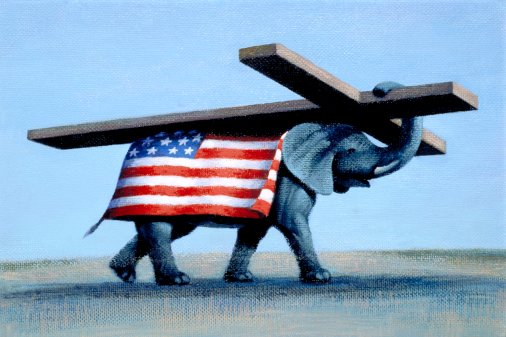
The desperate need of American political life is some sort of ontology of the nation, one that recognizes that I do not have my being, nor my freedom, outside of my relations with those around me. I can only receive freedom through others and I can only be free for others. And this type of freedom is only made possible through some sort of submission to authority. Such an ontology is obviously dependent on theology, and most will conclude that such a conception of freedom is impossible in modernity. What is possible, however, is that Christians wake up from their political slumber and stop arguing for the ‘conservative’, individualistic notion of freedom as if it directly equates to the freedom the Bible talks about.
(Addendum: Why am I picking on conservatives? Because I have so much more in common with them.)


Leave a Reply