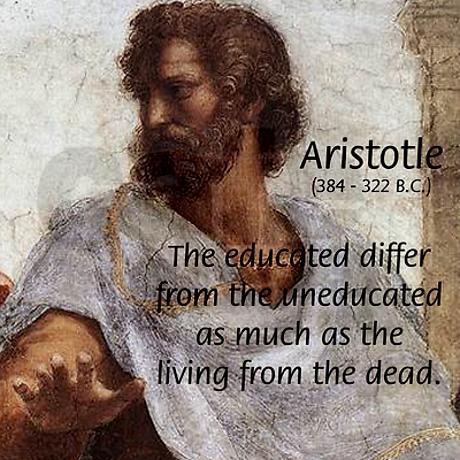
Aristotle on Educating Younglings

In my quest to uncover Philo of Alexander’s thought concerning the education of young people (my PhD Thesis topic), I found some interesting things in Aristotle’s Politics I thought I would share.

Aristotle thought the soul had two parts. The first was the irrational (αλογον) part. The second the rational (λογον) part. His idea was that the irrational part of the soul needed to be trained and tempered before the rational part could engage in the important work of philosophy. So, in his conceptual development of the ideal city, he prescribed the following things that should happen to the child in his/her different developmental stages. Overseeing all of this child development was an official of the city dubbed the Children’s Tutor (παιδονομοις). He was the CT of the City:)

Newborns to 5yrs old:

  • Needed to keep moving so their limbs don’t twist up.
  • It was a GOOD idea to expose them as much as they could handle to the elements (i.e giving them a cold bath in the river right after birth and leaving them uncovered when nursing). This served to toughen them up from the start and prepare them for life’s hardships. (Pol. 1336a. 20)
  • Let them play BUT:
  • Only games appropriate to their civil status. And it would be best if these games were designed to imitate their later life occupations. (1336a. 35-36) [I shudder to think what the playground rules for Castrate the Cow would be!]
  • They were not to engage in compulsory labor because it would put undue strain on their fragile bodies. (1336a. 25) [Take that Industrial Revolution!]
  • Tell tales and stories to them. But these must be approved of by the CT (1336a. 30)
  • Go ahead and let them throw massive tantrums when they don’t get their way. This improves their lung capacity and makes them ready for a life of hard labor. (1336a. 35) [My kids get to take part in hard labor when they throw tantrums, a win for both parties!! Clean those dishes!]
  • Don’t let them associate with slaves
  • Don’t expose them to indecent talk or images. And while you are at it Mr. CT, give those that intentionally expose children to these kind of things a good beating!  (1336b. 1-35)

Remember, all of these things we designed to create the ideal citizen who would then be an important part of the ideal city. The CT was a little bit of a teacher and a lot of a Moral Policeman. Can you imagine seeing an add for this positon on Monster.com?

What do you think?

You might also enjoy…

3 responses to “Aristotle on Educating Younglings”

  1. Ryan

    What I’m intrigued by is whether or not Aristotle’s analysis of the soul (irrational – rational distinction) is helpful when considering what the goal of Christian education ought to be. Certainly an irrational category helps describe something about us — but it seems to fall short of what Plato more generally describes as appetitive. That Augustine describes a form of “Christian education” as ordering the appetites under the law of Christ seems to me that most of church tradition has taken after Plato more than Aristotle on this, and for convincing reasons.

    But I don’t want to overstate my case here, especially since I’m unfamiliar with essentially anything Philo of Alexandria has written. Hope to see a response — but thanks for a great blurb nonetheless!

  2. Hi Ryan,
    Thanks for the comment! You make a great point about Augustine and most of church tradition following a Platonic understanding of controlling the appetites (especially in regards to sin). For Philo it seems like a lot of the action was happening within an individual’s soul. He believed the soul had two parts and the lower part (similar to Aristotle’s irrational soul) needed Reason to engage and subdue the passions, freeing the rational part of the soul to engage with the natural created order of the world. This in turn lead to a recognition of the incorporeal reality (ala Philo’s idea of forms). Ultimately the goal for Philo was the vision of God (the creator of the natural world and the discernable forms).

    Studying Philo is interesting because his thoughts are a conglomeration of Aristolian, Platonic, Stoic, Jewish, and other philosophy. He basically has his own version of philosophy and is an original and creative thinker. This blog was born out of an attempt to understand some background to what Philo’s thought. I thought Aristotle’s comments on child rearing were pretty interesting. When I asked my 11 year old if I should use some of Aristotle’s methodology to build him into a model citizen he looked at me like I was a crazy person. He emphatically stated I was doing a pretty good job already and there was no need to change anything:)

  3. Thanks for the interesting post, Josh. While some of the instructions pertaining to child rearing seem to be a little ridiculous in our modern context, one can see how the goal of today’s parent is very much the same in essence: to prepare a child to be a successful adult (which also includes being a contributing citizen, I think). Christian education has Christ-likeness as the goal, but parenting in general encompasses a wide range of skills that need to be imparted to a child. So, there’s probably a bit of the CT in every modern parent… just different cultural norms and values guiding the process.

Leave a Reply

Your email address will not be published. Required fields are marked *