
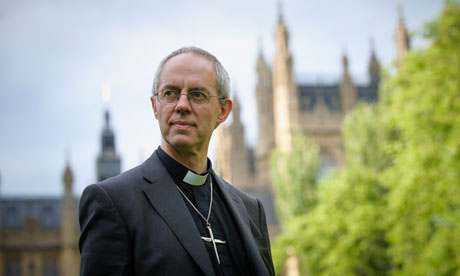
Just before the weekend, the Guardian and the Huffington Post reported that Justin Welby, the Anglican Archbishop of Canterbury, sometimes doubts the existence of God.
When I saw this story pop up on my Facebook newsfeed I almost neglected to read the article. “So what?” was my initial thought. Making this a news story stems from a fundamental misunderstanding about what faith actually is. However, for the Huffington Post this is apparently a rather surprising fact. The article begins, “Even the Archbishop of Canterbury struggles with doubt.” The word “Even” here obviously suggests that, of all people who ought to be certain about God’s existence, it would surely be a major representative leader of Christianity. But it doesn’t stop there; the staunch Atheist, Richard Dawkins, posted the interview on his website. Clearly surprised, Dawkins begins his post with “Well, I never!”
But why is it surprising that a Christian leader has doubts? Furthermore, why is it surprising that any Christian has doubts? It is only surprising if we imagine that faith means, by definition, the absence of doubt.
However, the opposite of faith is not doubt, but disbelief. As well, the opposite of doubt is certainty. Having faith is not the same as having certainty. If you know something is true, then it is no longer a matter of faith; you don’t believe it, you know it. So faith and doubt are really two sides of the same coin. This is because faith is believing despite uncertainty. Whether we are talking about a Christian leader or the average layperson, doubt should not possess the shameful stigma that many attribute to it, nor should it be found shocking to the skeptics. I would go so far as to put it like this: to say that one has faith is to say that one has doubts. Otherwise, we’re no longer talking about faith at all, we’re talking about certainty.
The biblical picture of faith is never equated with certainty. Paul often talks about the incompleteness of our knowledge; we see dimly as in a mirror and have partial knowledge (1 Cor 13.8–13). As well, faith is hope in the unseen, the unknown (Rom 8.24–25). This is not to rule out confidence or assurance, since this is how the author of Hebrews defines faith (Hebrew 11.1; NIV), but again we should not think of faith as synonymous with certainty, nor, especially, as the antonym of doubt. Certainty will come when we see God face-to-face (1 Cor 13.8–13). This is why faith, hope, and love are so important, but ultimately love is supreme (1 Cor 13.13); what need will we have of faith and hope when God is all in all?
One of my favorite pictures of faith comes from the Gospel of Mark. A father who longs for his boy to be healed by Jesus declares, “Lord, I believe; help thou mine unbelief” (Mark 9.24; KJV). Whenever I think of issues of faith and doubt I am reminded of this scene. It is entirely possible for faith and doubt to co-exist; indeed, I believe it is so. Faith and doubt are not the odd bed-fellows that many assume them to be.
So if doubt is inevitable, let’s doubt wisely. As John Donne once famously wrote:
Though truth and falsehood be
Near twins, yet truth a little elder is;
Be busy to seek her; believe me this,
He’s not of none, nor worst, that seeks the best.
To adore, or scorn an image, or protest,
May all be bad; doubt wisely; in strange way
To stand inquiring right, is not to stray;
To sleep, or run wrong, is. On a huge hill,
Cragged and steep, Truth stands, and he that will
Reach her, about must and about must go,
And what the hill’s suddenness resists, win so. (John Donne, Satire III)


Leave a Reply