
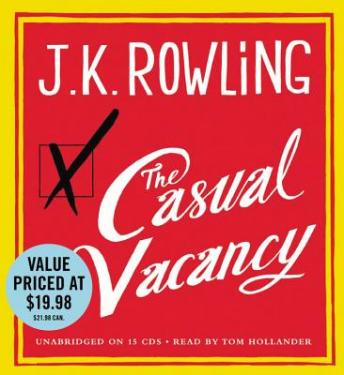
J. K. Rowling has written a new book. Did you notice something in that sentence? Those who know my affection for the Harry Potter series should immediately recognize that my opening sentence ended, not with five exclamation points, but with a period. Sadly, I am not too thrilled about this book. And this is coming from a self-proclaimed ‘Pothead’ (my endearing term for Potter fans). I have always been on the defensive for Rowling, arguing that she is a brilliant writer and that she deserves to be taken seriously. I had the wonderful opportunity of participating in the UK’s first academic conference on Harry Potter here at St Andrews, where I presented a paper on the morality of death in the series. I mean, I’m a big Rowling fan and I was really excited for this book ever since I first heard that she was working on an ‘adult book.’ A week before it came out I matter-of-factly asserted that I’d read anything Rowling published, even her grocery lists. Well now I’m singing a different tune. Here is my review. If you plan to read the book I’d recommend not reading any further as this post contains SPOILERS.
Summary
The Casual Vacancy is a story about the treatment of the disenfranchised and the marginalized within society. Set in the British town of Pagford, local politicians, social workers, doctors, and business owners argue about whether or not the nearby “projects”-like neighborhood called, The Fields, should belong to them or the nearby town of Yarvil. The plot is set up early in the book when the “Pro-Fields” politician, Barry Fairbrother, passes away from an aneurism. Thus, the outcome of The Fields and the rehabilitation center becomes an open question with various Pagfordians positioning themselves on either side of the debate.
What I Liked
The narrative weaves together several characters from the small town of Pagford. The structure is quite similar to movies like Crash, Magnolia, Love Actually, and others. This is something I really enjoyed. The narrative lacks a true protagonist, though arguably the main character of the story is the one who dies on the fifth page of the book, Barry Fairbrother. Although he was absent from the bulk of the 500 page story, it still felt like he was an integral character in the plot, which was something I definitely appreciated. This ultimately allows Rowling to explore so many additional characters and by the end they all had been well-developed.
I also appreciated the message of the book. In the process of debating which town gets The Fields (because no one actually wants to claim them), the marginalized within that neighborhood continue to plummet into darker despair. This culminates in the tragic deaths of Terri Weedon’s children (Terri is a prostitute and drug addict). Even after the deaths, the same folks who debated who would claim the ownership of The Fields now debate the location of the funeral and the placement of the bodies. Additionally, at the funeral, the book ends with Terri walking down the aisle of the church and the final words “the congregation averted its eyes” communicates the final blow to the reader. Civilized society simply despises the marginalized. This is a great message.
What I Didn’t Like
Despite having a great message, the process was underwhelming. When you remove the endless possibilities that a magical world affords, Rowling’s creativity as a story-teller is noticeably affected. The story lacks intrigue. There is no mystery, there is no twist, and there is no magic (in every sense of the word). The message of the book could have been communicated with a better story than this one.
Rowling told everyone that she was going to write a book for adults. If this book was made into a movie it would be NC-17. The book contains vulgar profanity, teen sex, prostitution, rape, pedophilia, drug use, overdosing, the watching of pornography, self-cutting, domestic violence, adultery, the neglect of a lesbian daughter, and a forty-year old woman fantasizing about teenagers. Now, I would have felt that this material was justified if the plot was more compelling and intriguing. Magnolia, for instance, is incredibly raw yet entirely appropriate within that context and communicates a powerful message. In The Casual Vacancy it was simply distracting. It felt forced.
What the teenagers do in this book is awkward in its own right, but even more so considering the shadow of Harry Potter that is cast upon this book. Rowling can write about whatever she wants ‘for adults,’ but why does she turn the teenagers into adults in the process? This connection with children’s literature is the main problem I have with the contents of the book. In the copy of The Casual Vacancy that I have, the second page contains the title, “Also by J. K. Rowling,” and everything on there is Harry Potter related. The people who are going to read this book know about J. K. Rowling because of Harry Potter. She’ll never be able to entirely transcend that association.
To enter into a bit of an excursus, though a related one: Hogwarts is essentially an a-sexual place (though there is the occasional snogging). This is precisely why I was opposed to the announcement by Rowling that Dumbledore was gay. It’s not that I have theological or moral qualms with the idea that cause me to defend his heterosexuality. The reason I was opposed to it is because the professors at Hogwarts are largely a-sexual. They are single people who live year-round in a remote castle. None of them have relationships, though some of them have unrequited love from childhood (e.g. Snape). If anything, Dumbledore may be in the same category as Snape in his ambiguous relationship with Grindelwald (so, we may say he’s same-sex attracted). All the ambiguities surrounding Dumbledore though came about after the series was completed, which raises the question of authorial intent (Rowling’s comments on Dumbledore’s sexuality sound too much like an abstract artist who inserts new meaning into her work as it comes to her). With The Casual Vacancy it was clear that Rowling wanted to make everything loud and clear. And the result is one incredibly awkward book.
Conclusion
Frankly, I don’t think I can recommend The Casual Vacancy. If books that combine small town British politics and teenage sexual angst is your thing then this is the book for you! The one silver lining is that Rowling’s book does have a noteworthy aim. The Casual Vacancy is a prophetic parable about helping the poor and the marginalized (perhaps with more emphasis on the government’s role in this?). I appreciate that she has used her story-telling gifts to send a message to the world. Although the aim of the book was noteworthy, the overall plot was not compelling enough and I found myself bored at several points. Ironically, her children’s literature was way more sophisticated than her book intended for adults.
The Casual Vacancy was quite clearly an attempt by Rowling to show that she has an edgy side and that she can transcend the confines of children’s literature. But why try and distance herself? What does she have to prove? She’s already a billionaire and she’s received several honorary doctorates for the Harry Potter series. What should she have done after Harry Potter? In my opinion, she should have tried to demonstrate that she really is one of the best writers of the contemporary era and not just someone who got lucky. Jane Austen would never have written The Casual Vacancy, and that should tell you something.


Leave a Reply