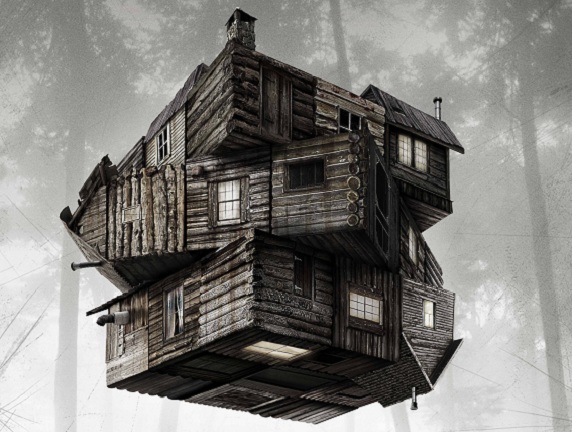
Cabin in the Woods & Good Friday

I have been waiting to review one of my favorite movies from 2012 for quite some time, Cabin in the Woods. As soon as I saw it I knew I needed to blog about it, and more importantly, I knew I needed to review it this week—Holy week.

Perhaps you’re thinking, this is totally random; why is he reviewing a movie from last year during a time when he should be reflecting on things like Lent, Palm Sunday, the Passover, the Exodus, Good Friday, Easter, and the Resurrection!  If you’re thinking this and you’ve seen the movie please keep reading, but chances are you haven’t seen the movie if this is your knee-jerk reaction. If that is the case, please do not read further UNLESS you promise me that you’ll never ever see the movie. Otherwise everything will be ruined and the movie will not be nearly as enjoyable. So now’s your chance. Please exit out of this page and never look at this post again until you see the movie. For all others: you’ve been warned.

***SPOILERS GALORE AHEAD***

What is obvious about Cabin in the Woods is that it is subversive. Although a celebration of the horror genre, it is simultaneously a critique. By all appearances this movie is simply another generic horror flick. It’s called Cabin in the Woods for goodness sake—how bland can you get! But this is all set-up for the subversive nature of the movie. Several common horror-movie tropes are exploited and given a (playful) rationale so as to explain and excuse some of the silliest of all tropes—such as, the over-sexualized blonde girl, the arrogant jock, the “virgin”, the creepy gas-station with even creepier clerk, the GPS not working, and phrases like, “let’s split up.” This is what makes Cabin in the Woods so much fun for those who enjoy the Horror genre and especially the classics like The Evil Dead franchise, to which Cabin in the Woods is a clear hommage with its replica Cabin (PS at this point I should direct those of you who find the genre questionable to an earlier post of mine).

But whereas the subversion of the horror genre is commonly noted and appreciated among fans of the movie, there is still yet another level of subversion on display in the film; the subversion of various notions of “atonement”.

This is why I’ve been waiting to review this movie for Holy Week.

Within the mythology of Cabin in the Woods we are led to believe that all horror movies are actually real life rituals intended to appease the “gods.” Thus, this movie is a reflection on the notion of sacrifice from start to finish. The opening credits begin with blood flowing across a black backdrop, which contain ritualistic scenes of sacrifice. And it goes without saying that the images depict primitive sacrifices. When Mordecai – the creepy gas station clerk known as “the harbinger” – calls the control room he says, “the lambs have passed through the gate… they are the gods’ fools.” And when each of the characters die, a lever is pulled which causes sacrificial blood to fill the outline of one of the archetypal figures that each victim represents in the larger ritual. After Jewels dies, Sitterson, one of the control room administrators, prays, “this we offer in humility and fear, for the blessed peace of your eternal slumber, as it ever was.” And of course at the very end of the movie we get an explanation from the Director herself (played by Sigourney Weaver): “It’s our task to placate the ancient ones, as it’s yours to be offered unto them.”

What all of this amounts to is essentially a critique of organized religion. The control room, with all their light-hearted gambling and orchestration, are the detached priests and pastors of this “religion.” In fact, the control room administrators even reflect on their role in this regard at one point. After Dana kills one of the zombified freaks, Hadley says to Sitterson, “remember when you could just throw a girl in a volcano,” to which Sitterson replies, “how old do you think I am?” This subtle interaction shows the analogy between primitive attempts to appease the gods made by priests of yesteryear, with their current organized system.

The subversion of religion and various atonement theologies can also be seen in the response of Dana and Marty in the final scene. In the face of the wrathful gods, these characters adopt a nihilistic stance, light up a few cigarettes, and say a few jokes; ultimately leading to the destruction of the entire planet.

But this is what seals the deal for me: Cabin in the Woods came out April 13, 2012. That is, it didn’t come out in October, when all the horror movies typically come out, but it came out the week after Good Friday (April 6, 2012) and Easter (April 8, 2012), and the day before Passover ended (April 14, 2012). When the sacrificial imagery in the movie is recognized as subversive of concepts of atonement, as I’ve attempted to show, the timing of Cabin‘s release can hardly be viewed as unintentional.

This means that the filmmakers wanted viewers to walk into the theaters with the grand narratives of atonement fresh in their minds—the Passover and the atonement theology inherent within it as well as the death of Jesus on the cross. It is in that context that the movie finds its ultimate subversion.

But this critique is nothing new. Many people find the notion of atonement too messy, distasteful, and primitive. Some have called the Christian atonement “cosmic child-abuse.” There are many within the church who believe that cultic references to Jesus’ death as “propitiation” (ἱλαστήριον; ἱλασμός) — which means appeasing God’s wrath — should be dismissed in favor of terms like “expiation,” which cut out the notion of wrath.

Though many want to reject propitiation and its connotations, I cannot follow suit. The wrath of God against sin has been appeased—this is good news! Maybe as you’re reading this you’re thinking, But isn’t God a God of love? Why are we talking about wrath just now? Jesus came as a demonstration of God’s love, not to appease his wrath!  To be fair, there is a biblical logic to this. 1 John 4.8 declares that God is love, and 4.9 declares that God sent his Son to demonstrate that love. But in fact, the next verse demonstrates the false dichotomy inherent in separating the love of God and the wrath of God when we talk about the atonement: “In this is love, not that we have loved God but that he loved us and sent his Son to be the propitiation for our sins” (1 John 4.10 ESV). This is surely a beautiful mystery. I love the way John Piper puts it, “The wisdom of God has ordained a way for the love of God to deliver us from the wrath of God without compromising the justice of God.” Praise God that, unlike the capricious gods from Cabin in the Woods, our loving and gracious God appeased his own wrath, and we don’t have to ritually offer up sacrifices, let alone human ones! So to close, I simply want to echo the words of the author to the Hebrews (9.13-14 ESV): “For if the blood of goats and bulls, and the sprinkling of defiled persons with the ashes of a heifer, sanctify the purification of the flesh, how much more will the blood of Christ, who through the eternal Spirit offered himself without blemish to God, purify our conscience from dead works to serve the living God.”

John Anthony Dunne

You might also enjoy…

9 responses to “Cabin in the Woods & Good Friday”

  1. Raymond Morehouse

    I just watched Cabin in the Woods this weekend, and I guess I am in the minority who didn’t like it.

    For starters: I read somewhere that it was “Joss Whedon’s answer to torture-porn.” Which it wasn’t. What I find most disturbing about that style of horror is that it places the audience in the role of the villain. How? The villain in the slasher/torture movie delights in the graphic deaths of his/her victim. But this is precisely what draws the audience in. This is why the genre has been so aptly labeled “torture-porn.” Saying you watch movies like this for the plot, characterization, clever dialogue, etc. is like saying you read Penthouse for the interviews. Cabin in the Woods wasn’t an answer to the genre, it was the genre.

    Second: I was lead to believe that there was some incredible plot twist. But this never came. If a viewer didn’t figure out what was going on after the first twenty minutes then they weren’t paying attention. I kept waiting for the clever plot twist, or subversion of the genre or whatever but it never came. It never transcended what it actually was: a gory slasher horror movie. The only difference is that it is an overt attack, as you point out, on atonement and a wrathful god.

    So in my mind it is doubly corrupt.

    As an artifact of a fallen world there is certainly a lot a Christian thinker can draw from such things (i.e. how NOT to think, how NOT to act), but our reactions are telling. I left this movie feeling slightly sick, disappointed, and sorrowful over the state of the world. If your analysis is correct, and I think it is, my reaction was appropriate and perhaps even necessary.

    I didn’t leave it, as I am sure many did, and as it was DESIGNED TO DO thinking, “That was a COOL movie!”

  2. John Anthony Dunne

    Raymond, thanks for your thoughts. As for the plot twist, I’m sorry you weren’t impressed, but upon re-watching the movie there are a lot of subtle things going on that make the movie interesting. The more observant one is the more readily recognizable these are as for the direction of the film. And you’re right that the movie places the audience in the role of the villain, but I disagree with you on how that works. I don’t think the movie is torture-porn, as you call it. I’ve watched a lot of interviews and commentaries and the filmmakers were actually quite subtle until the end where everything was meant to be over-the-top and ridiculous. BUT to get back to the role of the villain… the audience is the villain because the audience is part of the narrative itself. “You gotta keep the customer happy,” as Sitterson says. So rather than deplore our complicit role in the events, this should be seen as a work of genius (in my opinion). The horror genre is being subverted, and additionally, how we conceive of the genre as entertainment is being subverted as well. This is why I enjoyed the movie so much. There’s a lot of nostalgia wrapped into it as well which makes the movie entertaining, but I was struck by the clever wit throughout.

  3. Sam

    Thanks for an intriguing post…I have to say that the Piper quote that is supposed to be so fantastic is, in my opinion, just a bit of clever but lazy theology. God’s wisdom is some mediating act of ingenuity to satisfy two competing interests…love and wrath? I’d rather see us wrestle with what it means for God’s love to be wholly consistent with his wrath rather than pit these against each other. The accusation of cosmic child abuse is a serious one that gets at this inconsistency. God’s wrath must be understood as God’s loving response to human sin, not as an equal interest alongside God’s love.

    I agree with Raymond on the film.

    1. John Anthony Dunne

      Hey Sam, thanks for responding and sharing your thoughts. I guess the nuts and bolts of my concern is that we just need to refrain from making wrath and love antithetical, and since I’m not a theologian, I’m not quite sure what that looks like, but since the Bible holds them together I want to do that as well. In the Western tradition I can appeal to the simplicity of God’s nature and the unity of his attributes, but as a NT student, I’m less inclined to jump to those categories. So I’m thinking more functionally than essentially. Anyways, thanks for your comment.

      1. Sam

        Thanks, John….I appreciate your desire to hold together God’s love and God’s wrath and I do see that in your post. My concern is that Piper’s simple formula doesn’t tell us that God’s love is the broader context in which we see his wrath, rather it places them as equals to be cleverly mediated by his wisdom. To make that claim in the context of the movie which depicts gods who are wholly wrathful is to miss the way God’s wrath is only understood in the face of his great mercy. The wrath of the deities in the movie is nothing like the wrath of God. It needs to be emphasised that there are absolutely no similarities. That’s why I think the movie is a poor way in to talking about the wrath of God…but the language of propitiation and appeasing the wrath of God makes an argument for similarity. Am I wrong? Are you saying that this movie critiques (through satire) an aspect of atonement theology that we really ought to embrace?

        1. John Anthony Dunne

          Yeah I can see your critique of Piper’s quote. As a non-theologian who has not reflected critically on the relationship of these attributes, or the others for that matter, I am not sure how they relate, though I appreciate your perspective on wrath in context of love (a ‘subset’ of love?). I’m not sure that I’d say that specifically, though I could change my mind, but I agree that God’s wrath is far different than the deities from Cabin. That is why I called them capricious. I certainly could have emphasized that more, but my focus was on propitiation, which I want to maintain and embrace as a concept. I’ll let the theologians tease it out for the rest of us!

  4. Paul Sloan

    I want to comment on a few different aspects, so I’ll try to do them one at a time, and maybe in more than one comment:
    The movie per se: Like John, I really appreciated the sense of humor and what he called the “subversion” of the horror genre, while at the same time “celebrating” its universal tropes. And I agree with Raymond that there isn’t what I’d call a “plot twist,” but rather a slow zoom out in which you finally see the whole picture. From the beginning, the viewer knows something is amiss as the perspective keeps alternating between the college kids and the “manipulative underground priests”, but you don’t get the whole narrative logic till the end, though it’s teased throughout.
    Also, in dialogue with Raymond, I want to wonder about why people like horror movies. Raymond mentioned that the audience is drawn into the delight of the death of the victims – which is likely certainly true for many. But I wonder if there is something deeper, possibly vindicating, but also possibly more dangerous. For example, I like horror movies, and I’ve recently been trying to figure out why. Because, as it turns out, when watching, I actually cover my eyes (and sometimes ears) when it comes to the act of killing. I don’t want to see the blood or the choking or the action of the knife, etc. So what is it that engrosses me during the films? I wonder if it’s simply the “thrilling” aspect, the somewhat voyeuristic element of getting to “experience” danger without having to actually undergo any of the heartache, pain, etc. Or I wonder if, being a theology student, and therefore constantly steeped in questions of evil, the human condition, and more particularly, what God has done and will do about it all – I wonder if I’m just intrigued by the plot which has pretty archetypal manifestations of these questions – a (super)human villain who’s “fallen” and has bent desires, and seeks to destroy, and (sometimes) good counterparts who are trying to resist and defeat whatever evil is plaguing them. (At this point, I should remind that this is a wondering – definitely feel free to blast me if/when I’m mis-thinking here.) This leaves lots of questions unanswered, of course. Such as, are those good enough reasons to subject your mind to the (usually) surrounding filth of such movies (gratuitous sex, language, and nihilistic plot conclusions)? Also, is there something wrong (deeply so?) with that voyeuristic aspect – of wanting to experience danger from afar, particularly the sort of danger that leaves its victims as bloody messes? Or, on the other hand, is the genre vindicated at all by (typically) being the one genre whose characters are definitely identifiable? Usually, everyone knows who the bad guy is (in principle; e.g. in Scream you don’t know who the masked killer is, but you know the masked killer is the bad guy), and you know who the “good guys” are. This seems safer to me than a movie like, say, Scarface, in which you really are rooting for Tony Montana, a drug dealing murderer. The weaknesses of this, of course, is that it may not be true to real life. Often the “bad guy” is not so easily-identifiable. At this point I feel I may have gone a little off-topic, and I’ll try just to stick to the atonement aspect.

  5. Paul Sloan

    The atonement aspect is an interesting one, because at its *most basic level*, there is overlap. The deity is angry due to “transgression” and requires “sacrifice” for appeasement. I think it’s at this point that the overlaps cease. As Sam said more succinctly than I will, the character of the “gods”, and the nature of their relation to the world, is of course completely different – and this affects the narrative logic, I think. In Cabin, the gods are ancient, corporeal, below-the-earth dwellers, who desire to *annihilate* the world if not appeased. The differences are obvious and need not be overly-drawn out. Israel’s God is the Creator who loves the world and wants to renew it and rescue it,and I think it’s in this context, as Sam pointed out, that God’s wrath is a subset of His love. His wrath toward Sin springs from His love for the world. It’s because He loves the world that He is wrathful toward Sin, which is an “anti-Creation” force. Admittedly, I’m really more “thinking/typing aloud” here. Because any additional comments on that from my end would really just be affirming what others have already said better than I, I’ll just pose a question to John: What did you think of the portrayal of the will in the movie? Was there anything problematic? And if so, do you see any overlap in the movie’s portrayal and the way some Christians (certain theologies) talk/think about the will? What I’m getting at is, e.g. the fact that the priests at one point say, “It’s all of their own free will. If they don’t transgress, they don’t suffer” (paraphrase). But of course, they’re being put in all the precarious situations, and eventually, are being overtly manipulated by pheromones and gases. But it’s not making them act against their desires, necessarily; rather, it’s changing their desires with the natural consequence that they do it of “their own free will.” Any thoughts on that aspect?

    1. John Anthony Dunne

      Hey man, I don’t have too many thoughts on the issue of the will. I certainly noticed that those issues were surfacing, especially since the “priests” are “puppeteers” but what makes me hesitant to find a perspective on determinism vs. libertarian free will is that it is the priests, not the gods, who are in charge, and it is the victims of the sacrifice, not humanity as a whole, that is it in view. What does it mean for a sacrificial lamb to “transgress” or for a sacrificial offering to “have freedom”? That being said, obviously the gods only find the sacrifice of those who transgressed as worthy of satisfying their wrath. Maybe this can be teased out into a comment on the freedom of the will or something like that, but I’m not prepared to reflect too deeply on that subject. What are your thoughts?

Leave a Reply

Your email address will not be published. Required fields are marked *