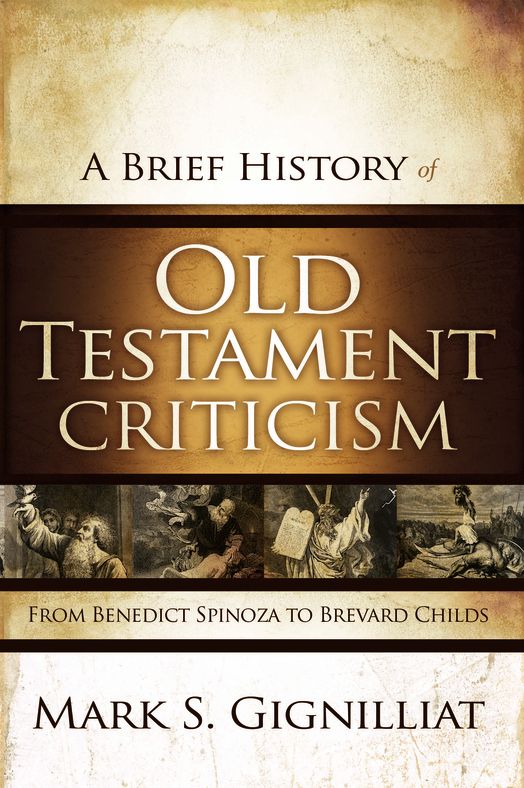
A Brief History of Old Testament Criticism—by Mark S. Gignilliat (A Review)

On my trip to India over spring break—which you can read a little bit about here—I brought along a delightful little introduction to Old Testament Criticism by Mark S. Gignilliat, called, A Brief History of Old Testament Criticism: From Benedict Spinoza to Brevard Childs (check it out on Amazon). Gignilliat, who is Associate Professor of Divinity/Old Testament at Beeson Divinity School (Samford University), holds a doctorate from the University of St Andrews (which is, btw, a #legit University; check out this video for proof). I absolutely enjoyed reading this book and I think many of our readers here at The Two Cities would benefit from it.

In general, I love reading books that overview various movements within scholarship (in a word: Forschungsgeschichte). I find these to be a helpful way to synthesize how various ideas came about and where they fit historically, both in relation to the contexts and cultures that produced the ideas and the where those ideas fit within the history of a given discipline. Within biblical studies some of the more interesting and helpful have been Schweitzer’s Paul and His Interpreters, Neill & Wright’s The Interpretation of the New Testament: 1861–1986, and Hasel’s Old Testament Theology: Basic Issues in the Current Debate (and, I should say, once N. T. Wright’s forthcoming Paul and His Recent Interpreters emerges it will be a fantastic read as well). And so, because I enjoy books like this a lot, I thoroughly enjoyed reading A Brief History of Old Testament Criticism.

The book is broken down into seven chapters, each looking at the life and contributions of the most significant and influential scholars within the history of Old Testament Criticism. The chapters are on Benedict Spinoza (1632–1677), W. M. L. De Wette (1780–1849), Julius Wellhausen (1844–1918), Herman Gunkel (1862–1932), Gerhard von Rad (1901–1971), William Foxwell Albright (1891–1971), and Brevard S. Childs (1923–2007). It was fascinating to recall the development of ideas related to Old Testament Criticism, to see how they connect and develop, but also to get a better sense of who the people were who made such paradigm-shifting contributions to a field that is still largely indebted to their scholarship.

I do have one minor quibble with the book. The book feels a bit like a Heilsgeschichte—the advances of scholarship lead to a historical-critical climax in the work of Brevard S. Childs. So the structure of the book functions as an implicit argument for Childs’s work. As well, Gignilliat cites Childs throughout (e.g., pages 49, 99, 103, 119, 141) and what he says in the conclusion of the Brevard Childs chapter is certainly the most positive of all the others surveyed in the book (pp. 165–167). Gignilliat even admits in the postscript: “As the reader can tell, I have high regard for the canonical approach and Brevard Childs” (p. 169). Since Childs was Gignilliat’s Großdoktorvater—Gignilliat studied under Christopher Seitz—it is certainly to be expected that Gignilliat would favor the work of Childs. When critiquing the ideas of those surveyed in the book, Gignilliat would often  say very Childs-esque things and things in keeping with the “Theological Interpretation of Scripture” [TIS] movement. At times this was quite jarring for me since these criticisms were written in a way that suggested to me that the implied reader would have the same TIS sort of opinions. Since I don’t share that perspective I found myself pushing back at times and scribbling my rejoinders in the margins. Rather than recount all of the examples of this I just want to notify readers of the book’s overall perspective (e.g., pages 26, 27–28, 84–85, 89–90, 99, 118, 121 for TIS comments). I especially take issue with the expanded TIS comment on page 140. Although Gignilliat reassures the reader that history is important for interpreting the Old Testament, he critiques those who use biblical backgrounds as a “Gnostic key” to unlock the meaning of the Bible. But what’s truly Gnostic:  to downplay the historically and culturally conditioned nature of the Bible, or not?  Without pressing this any further, I’ll just state that I’m not the biggest fan of the TIS movement; the task of exegesis is not over!

All said, A Brief History of Old Testament Criticism by Mark S. Gignilliat is a fantastic book worth reading. I think this book would be especially beneficial to those who went through Seminary and have a vague idea of the major players involved in Old Testament studies, or those who weren’t really introduced to Old Testament Criticism at all. But also, this book would be a fantastic introduction for students, even at the undergraduate level. If I ever get the opportunity to teach an Old Testament Survey course I would love to supplement my lectures with Gignilliat’s text. So as a final assessment, I certainly recommend this book, especially to undergraduates and seminarians.

I would like to thank the fine people at Zondervan Academic for sending along this review copy to me.

John Anthony Dunne

You might also enjoy…

6 responses to “A Brief History of Old Testament Criticism—by Mark S. Gignilliat (A Review)”

  1. Joseph Hartropp

    hey john,

    (you don’t know me but i’m at st andrews and we met for like a minute at the whey pat ages ago, fun fact…) sorry to latch on to your passing comment but about the TIS movement, i’m very new to it but surely the point of it is exactly what you said ,that exegesis is never finished, that we need to keep returning to the text (with all the interpretive tools we have) to hear it again? But recognizing that the text is not just a means to events behind or in front of the text, but is and end in itself?

    thanks!

    1. John Anthony Dunne

      Hey Joseph, thanks for reading and commenting. Are you studying Divinity at St Andrews?

      As for TIS, there are a lot of little things about it that bug me. If an interpretation is not historically plausible within its own historical/cultural context then it is not an interpretation worth having. The reason why I said that the exegetical task is not over is because all add-ons to exegesis, whether they be postmodern hermeneutical lenses or niche “readings” of scripture all convey to me that many think that traditional exegesis is over and we need to move on to new methods in order to get anything new out of the text or say anything new. I’ve heard TIS people say at conferences that exegesis hasn’t provided definitive answers and since people use the same “objective” methods and arrive at different conclusions we need to move on, we need TIS. And this is why I want to emphasize that traditional exegesis is not finished. There’s still loads to be gained and we don’t need to “move on.” It’s all faddish in my opinion.

      1. Joseph Hartropp

        Hey John, thanks for getting back. Yes I am; i’m coming to the end of my 3rd year of theology/biblical studies. Its a cool thing. You’re phd-ing it with NTW right?

        Okay, well like I said i’m pretty new to it, we’ve just had a short module ‘reading the Bible theologically’ with Grant Macaskill which has kinda been exploring TIS. I suppose you’ve seen alot more of what TIS can look like but just from a first glance to me it seems like the way christians should (and often have) read scripture, e.g. ideas about effective church history, reading the text canonically, not looking through the text for something else e.g. ‘what actually happened’, letting the text address us as the church… Is that something different to what you’re challenging? I’m sure there are dangers e.g. completely ignoring history or authorial intention but I guess in many ways i’ve found elements of TI to be just quite refreshing especially when biblical studies just gets stuck on questions of authorship or historical accuracy and it can all feel a little dead. But I wouldn’t want to use something like TIS to oppose traditional exegesis, just work with it. But what do I know? My mantra is that when scripture is unclear, ask Dr Macaskill. Or NTW. If they disagree, draw lots or something. I suppose there are a range of TIS positions out there? To read scripture a-theologically, that wouldn’t be good would it?

        p.s. since we’re both in st mary’s i feel i should probably mention Barth somewhere. There you go. Barth Barth x

        1. John Anthony Dunne

          Hey Joseph,

          Yes I am indeed working with NTW. And I appreciate the compulsory Barth mention there at the end of the post. I need to read more Barth. I’m guessing you’re more of a Theology student than Bib Studies? I understand some of the concerns that you raise but I am overall fairly skeptical about the whole TIS thing. I’m not opposed to theological reflection or canonical links and things like that (I’m a Christian!), but there are good ways and bad ways of doing that. And if I get a sense that history and the author are being muted by a canonical/theological glaze or that an author’s words are taken to mean something that is anachronistic then I will not be happy : )

          1. Joseph Hartropp

            Well it s funny you should say that, in many ways i’ve actually got more time for the biblical studies department, as its alot more grounded and you can’t get away with just saying nonsensical things (most of the time). Unsure how I feel about Barth…plus i’ve only scratched the surface of his thought…yeah I probably agree with most of what you said about TIS there.
            But hey heres an example. Gen 15:1. “I am your shield, and your reward will be very great”…OR *and [i am] your very great reward*. lets say original author didn’t intend the latter more personal translation and was just talking about the land or something. But theologically, in light of the rest of scripture, are we not justified in taking the latter translation, and saying that God himself is our very great reward? And is that not TIS? Whadya reckon?

          2. John Anthony Dunne

            Hey Joseph, I’d say the right doctrine from the wrong text is always wrong. We should always strive for understanding what the text originally meant, and only then can we have any meaningful conversation about what it means for us. And it cannot mean for us what it did not mean for them. That’s just how I go about things. To give a random example, many people read Romans 7 as a depiction of Paul’s present struggle. I don’t hold that view (I think he is describing the difficulty of Israel-in-Adam trying to fulfill the Law without the aid of the Spirit). So whether you agree with that or not, I tell people that yes Christians still sin and that is clear from the NT elsewhere (like 1 John) but my point is simply that Romans 7 does not teach that as well. So you couldn’t say, well since we know Christians sin therefore Romans 7 must mean x, y, and z because that coheres with our broader theology. I would simply say that that is flat wrong and exegetical concerns decide the issue. I hope that clarifies some things!

Leave a Reply

Your email address will not be published. Required fields are marked *