
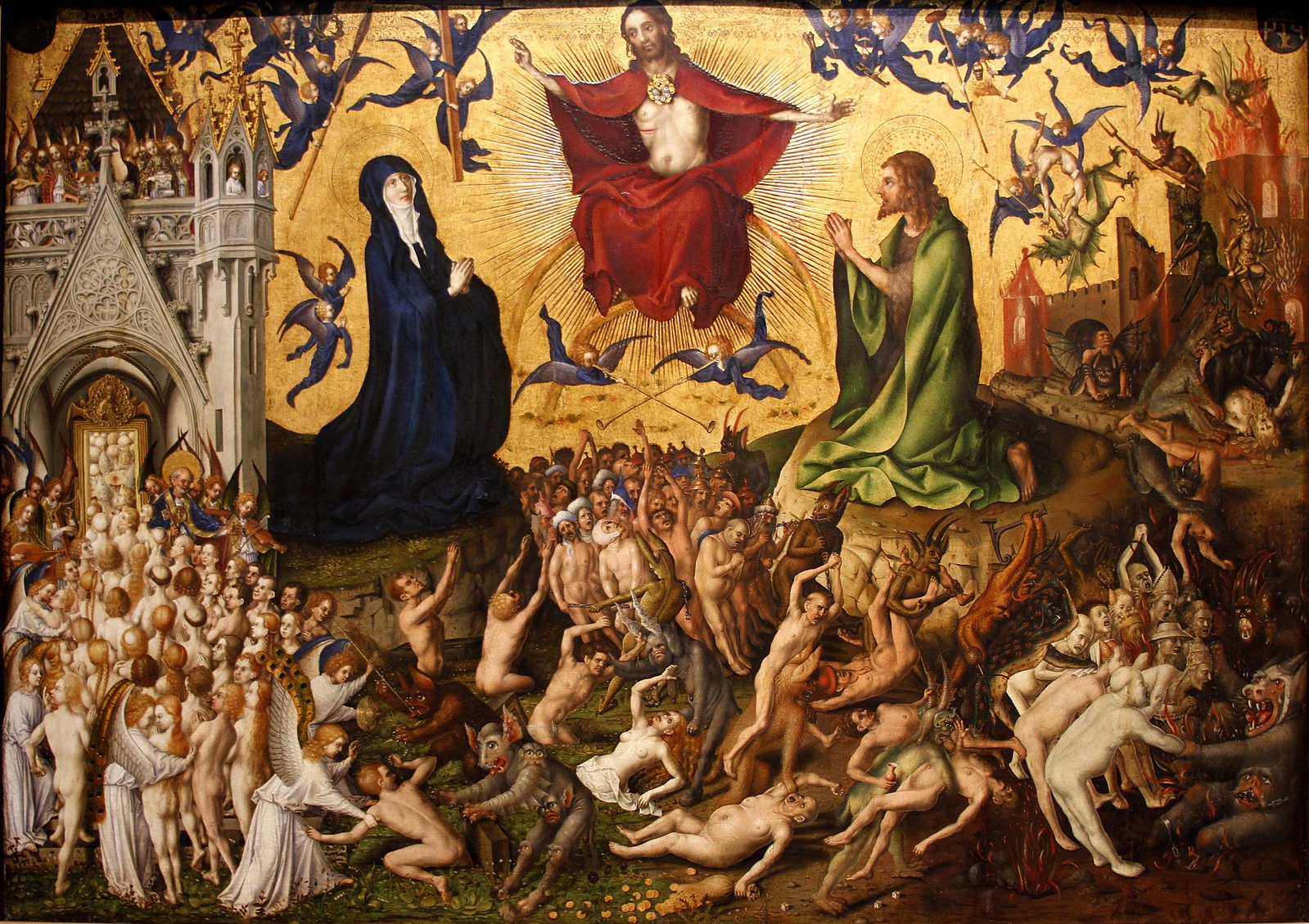
Photo credit: “The Last Judgement – Stefan Lochner – Wallraf-Richartz Museum – Cologne – Germany 2017” by José Luiz is licensed under CC BY-SA 4.0.
I recently heard it preached on the topic of perseverance. The preacher started by noting that we are saved by faith alone. This is correct. In Acts 13:39 (NLV) we read: “Everyone who believes in him is made right in God’s sight—something the law of Moses could never do.” Again, in Eph. 2:8-9 (NIV), we read: “For it is by grace you have been saved, through faith—and this is not from yourselves, it is the gift of God—not by works, so that no one can boast.”
The preacher went on to note that salvation by faith alone is not enough, and that we must by our own efforts persevere “to the end.” In support of his position the preacher cited a number of verses. For example, Matt.24:13 (NIV): “the one who stands firm to the end will be saved”; Heb. 10:36 (NIV): “You need to persevere, so that after you have done the will of God, you will receive what He has promised”; and James 1:12 (NIV): “You need to persevere, so that after you have done the will of God, you will receive what He has promised.” One can cite many other similar verses as well.
From this, the preacher concluded that while you are saved initially by faith, you must by your own efforts continue in that faith or else you will forfeit your salvation. There is much disagreement about whether a believer, once saved, can ever lose salvation. That is an issue I do not wish to address directly. Rather, I will approach the topic from the standpoint of Eph. 2:8-9 quoted above. A simple example will illustrate this. Believer A perseveres in the faith through his or her own efforts, while Believer B falls away. Believer A thus has something to boast about over and against Believer B; that is, his or her endurance. Whether Believer A actually boasts or considers boasting is not relevant. The point is that this believer would have cause to boast before God, in direct contradiction to the message of Eph. 2:8-9 that no one can boast about anything having to do with their salvation. This cannot be correct. There must be something else at work here that our preacher friend missed.
Again, one is saved by faith alone. Let us accept that as the bedrock principle of Christianity, although some might disagree. (If you wish to explore contrary views, you can read all about them in Four Views on the Role of Works at the Final Judgment, general editor, Alan Stanley; contributors Robert N. Wilkin, Thomas R. Schreiner, James D. G. Dunn, Michael P. Barber, (Zondervan, 2013). The question then becomes, once one is saved through faith alone, does Christ then leave the picture? In other words, is Christ “done” with us at that point when one accepts Christ as Lord and Savior?
Scripture would emphatically suggest that this is not the case. Christ continues to work actively in the lives of believers. For scriptural support, one might read 2 Cor. 3:18 (NLT): “So all of us who have had that veil removed can see and reflect the glory of the Lord. And the Lord—who is the Spirit—makes us more and more like him as we are changed into his glorious image”; and Phil. 3:21 (NLT): “He will take our weak mortal bodies and change them into glorious bodies like his own, using the same power with which he will bring everything under his control.” (emphasis added).
Now that we have established that Christ continues to work “on” or “with” us after we come to faith, I would propose that the next question is whether this process of transformation requires any effort on our part. Paul suggests that it does, Phil. 3:12-14 (NLT):
“I don’t mean to say that I have already achieved these things or that I have already reached perfection. But I press on to possess that perfection for which Christ Jesus first possessed me. Brothers and sisters, I do not consider myself yet to have taken hold of it. But one thing I do: Forgetting what is behind and straining toward what is ahead, I press on toward the goal to win the prize for which God has called me heavenward in Christ Jesus.”
There are other verses one might cite as well for the proposition that one must “strive” to “win the prize for which God has called” us: for example, Gal. 6:9 (NIV): “Let us not become weary in doing good, for at the proper time we will reap a harvest if we do not give up”; Rom. 2:7 (NIV): “To those who by perseverance in doing good seek glory, honor, and immortality, He will give eternal life”; and 1 Cor. 15:58 (NIV): “Therefore, my beloved brothers, be steadfast and immovable. Always excel in the work of the Lord, because you know that your labor in the Lord is not in vain.”
So, how are we to reconcile all of this? Is our salvation dependent in some way on our own efforts, or is it not? I would suggest that it is not in the sense that any of our efforts in this regard are Christ-inspired and Christ-completed. In other words, it is Christ who takes control of the believer’s life and inspires us and works within us during this life here on earth to bring about the spiritual transformation noted above. For scriptural support, I will direct our attention to 2 Cor. 5:10, a passage commonly referred to as the Judgment Seat of Christ, (NIV): “For we must all appear before the judgment seat of Christ, so that each of us may receive what is due us for the things done while in the body, whether good or bad.” This verse is commonly viewed as connecting one’s earthly behavior to one’s recompense or “deserts” under the general rubric of divine judgment. That is understandable if one accepts this translation. The problem is that this translation, long accepted as dogma, is incorrect. The proper translation, picked up or suggested by a few translations both old and new, reads something like this: “We must all appear before the Judgment Seat of Christ, so that each of us may receive in our bodies what is due us for what we have done, whether good or bad.” (For the analysis backing up this translation, see various articles published on this blog which can be accessed through the following link: https://www.thetwocities.com/author/tom-peters/.
What is the essential difference between the two versions? The common translation represented by the NIV and others is that Christ’s judgment takes place after the believer’s physical death in some apocalyptic future, while under the revised translation this judgment takes place while we are still in this life, that is, in our physical bodies. The key phrase in this verse from the underlying Greek text is τὰ διὰ τοῦ σώματος; literally translated “the things through the body.” The conventional translations relegated this theologically rich and powerful phrase into little more than a mere pleonasm; that is, it does little more than repeat what Paul a few words later in the same passage conveys by the Greek words πρὸς ἃ ἔπραξεν, or “what each of us has done.”
I am quite sure that there was some beneficial divine purpose in allowing this less than illuminating translation to persist for so many years, but now it is time for a change. The fact that Christ’s “judgment” of believers takes place in our bodies while we are still here on earth indicates that Christ is at work within us on a daily, indeed even minute-by-minute, basis, in this most personal and intimate of ways, that is, “through our bodies,” whether we are aware of it or not, all with the goal of preparing us for eternity; that is, so that “we are changed into his glorious image.” 2 Cor. 3:18. Thus, judgment accomplished through the body is the process by which Christ transforms us into his image, an image we will carry into eternity.
This is a great mystery and worthy of our joyful and grateful contemplation, even when this process at times can become uncomfortable: Rom. 8:18 (NIV): “I consider that our present sufferings are not worth comparing with the glory that will be revealed in us”; 2 Cor. 4:17 (NIV): “For our light and momentary affliction is producing for us an eternal weight of glory that is far beyond comparison”; 1 Peter 5:10 (NIV): “And after you have suffered for a little while, the God of all grace, who has called you to His eternal glory in Christ, will Himself restore you, secure you, strengthen you, and establish you”; and 1 Peter 1:6-7 (NIV): “In this you greatly rejoice, though now for a little while you may have had to suffer grief in various trials so that the proven character of your faith—more precious than gold, which perishes even though refined by fire—may result in praise, glory, and honor at the revelation of Jesus Christ.”
I close with Phil. 4:19 (NLT): “And this same God who takes care of me will supply all your needs from his glorious riches, which have been given to us in Christ Jesus.” The answer to the conundrum posed by this article is that while the Believer acts in and through the body, it is Christ who through the Spirit directs that action toward eternal life in a mysterious way that we cannot fully comprehend but for which we can be thankful, so that “no one may boast.”
For an interesting read with arguably comparable themes, you might take a look at Wischmeyer, Oda, Ego-documents on religious experiences in Paul’s Letters: 2 Corinthians 12 and related texts, (De Gruyter, 2020), accessible at the following link: https://doi.org/10.1515/9783110557596-010, where the author concludes that Paul uses his “physical condition as gift (cháris) of the heavenly Christ and thereby on a religious interpretation of the physical condition of his body. His body is interpreted as a place of revelation.” (emphasis added.)


Leave a Reply