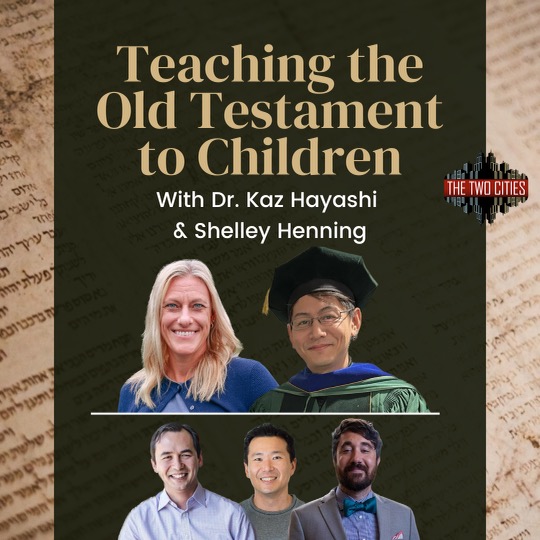
Teaching the Old Testament to Children with Dr. Kaz Hayashi and Shelley Henning (Podcast)

In this episode we talk about why it’s important to teach the Old Testament to children with Dr. Kaz Hayashi, who is Associate Professor of Old Testament at Bethel Seminary (St. Paul, MN) and Shelley Henning, who is the Co-founder and CEO of GrowFamily, which provides family resources for parents and church leaders, the Children’s Ministry Catalyst for the Reformed Church in America, and one of our recent graduates at Bethel Seminary in our Children’s and Family Ministry program. Together Kaz and Shelley co-wrote a recent article, “Teach All Scripture to Children,” in the children’s ministry magazine, Entre Niños. In our conversation we talk about the importance of engaging the OT, and not in a piecemeal way that selectivity skips over stories that make us as adults uncomfortable or even aspects of familiar stories that complicate the story morally or theologically. Team members on the episode from The Two Cities include: Dr. John Anthony Dunne, Rev. Dr. Chris Porter, and Dr. Kris Song.

You can find this new episode on SpotifyApple PodcastsGoogle PodcastsOvercastBreakerAnchor, or wherever you get your podcasts. Check it out, subscribe for weekly episodes every Wednesday, and please give us a rating and review!

John Anthony Dunne

You might also enjoy…

2 responses to “Teaching the Old Testament to Children with Dr. Kaz Hayashi and Shelley Henning (Podcast)”

  1. Brooke Hintz

    Hello,

    I’m writing in regards to your podcast “Teaching the Old Testament to Children with Dr. Kaz Hayashi and Shelley Henning.” While I appreciate the desire to teach children about the Bible and to discuss it in our homes and our Sunday Schools, I was troubled by some of the advice given. It didn’t seem like proper consideration was given to what we know of childhood development though years of scientific research. Ideas like reading the Pentateuch to young children seem strange when we would not consider it appropriate to read young children other stories involving rape, murder and genocide. I know that Aesop’s fables were mentioned as some support of the idea of reading difficult parts of the Old Testament to our children, but I think we should actually reassess the appropriateness of those stories for young children as well rather than using them as a model.

    I believe that honoring the way God made our children requires us to put in the work to meet children where they are at when we’re introducing them to Him. I also believe that the best place to start is with Jesus because he is our truest and best picture of who God is. I’ve very much enjoyed the work of Meredith Anne Miller (https://meredithannemiller.com) as I’ve taught my children about God and as I’ve taught Sunday School at my church. She talks a lot about helping children to learn to trust Jesus as a first step in introducing them to Him. She has a new book coming out (“Woven: Nurturing a Faith Your Kid Doesn’t Have to Heal From”). Perhaps that could inform further discussion of teaching children about the Bible about about God.

    Thanks for your time,
    Brooke

  2. Kris Song

    Thank you so much, Brooke, for your comments as well as your reflections and recommendations on this discussion. The nature of conversations like these on the podcast is such that there is not enough time to fully develop all of the important considerations that deserve their due attention. Comments like these provide some helpful follow-up to meet those ends.

    Your comments are well taken, and I am not sure we fundamentally disagree. First of all, the nature of the conversation does not promote general advice of the whole panel for how teachers ought to teach the Scriptures to young children; ultimately the prescriptive points belong ultimately to the authors as they present these ideas. Furthermore, as I understand the points made by our guests, they indeed recognize various degrees of development in young people and do not treat “children” as an undifferentiated group. I heard them (and read them) making the point that when dealing with the more difficult aspects of the Old Testament (and the rest of Scripture), wisdom and preparation is required in presenting these matters faithfully and responsibly (a step churches and teaching ministries often find themselves ill-equipped to make for various reasons).

    At some point, I think all of us would agree that all of Scripture should be fully taught and faithfully presented depending on where our young people are as they engage with the Scriptures. It appears from your comments as though you would prefer to allow these matters to be engaged as Christian Scripture and therefore to begin with how these more difficult matters are apprehended from the standpoint of Christ and our position in him. This is an approach that my own church would promote in our teaching of Scripture, and I am glad that you are offering it here.

    If I have misrepresented anything or if you would like to follow up, please do so and we’d be happy to engage further.

    Thanks for your comments,

    Kris

Leave a Reply

Your email address will not be published. Required fields are marked *