
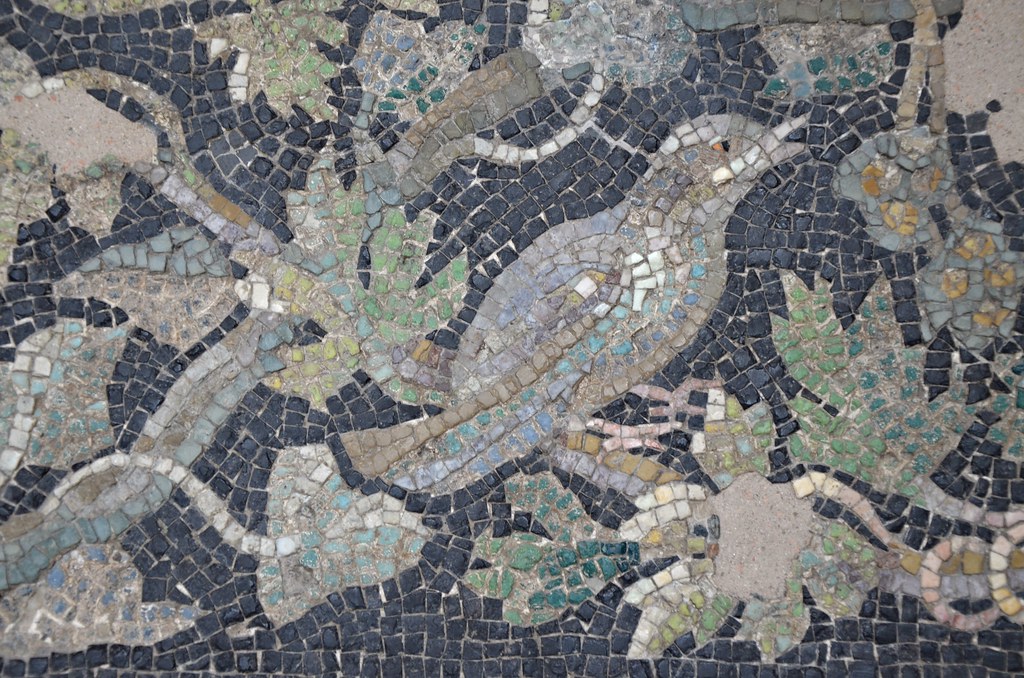
Photo Credit: “Mosaic of the Judgment of Paris (detail), 115 – 150 AD, from Antioch on the Orontes (Antakya, Turkey), Louvre Museum” by Following Hadrian is licensed under CC BY-SA 2.0.
Over the years there have been numerous hints and veiled suggestions in Christian literature that point (though never quite fully realizing the implications of these insights, which this post will attempt to do) to the idea of the Final Judgment of believers as representing a present reality, rather than some future forensic reckoning of rights and wrongs in an apocalyptic courtroom at the end of the age. For instance, N.T. Wright in Surprised by Hope (Harper One, 2008), 198 writes: “Salvation, then, is not ‘going to heaven’ but ‘being raised to life in God’s new heaven and new earth.’ But as soon as we put it like this we realize that the New Testament is full of hints, indications and downright assertions that this salvation isn’t just something we have to wait for in the long-distance future. We can enjoy it here and now (always partially, of course since we all still have to die), genuinely anticipating in the present what is to come in the future.”
Other scholars have expressed similar views, though stated somewhat differently. Richard B. Gaffin Jr. in Resurrection and Redemption: A Study in Paul’s Soteriology (2nd ed., P&R Publishing, 1987) 135, argues that “the resurrection of Christ is not only the basis but the beginning of the eschatological resurrection of believers,” so that believers in this life are already raised with Christ in a spiritual sense. Also, in By Faith, Not by Sight (2nd ed., P&R, 2013), 44–46, Gaffin describes this process of resurrection as “inaugurated eschatology.” Michael Gorman in Cruciformity: Paul’s Narrative Spirituality of the Cross (Eerdmans, 2001), 4, defines “cruciformity” as “conformity to the crucified Christ;” and, 27–29, where he develops the idea that Christian ethics are not merely imitative but participatory; that is, believers while still here on earth are drawn into the redemptive power of Christ’s self-giving love.
Eastern Orthodox theology likewise stresses the present transformational nature of Christ’s love. In Theosis edited by Vladimir Kharlamov (Wipf & Stock, 2011), 1–3, the introduction defines theosis as “participation in the divine nature” (2 Peter 1:4), emphasizing transformation into “Christlikeness” as the goal of salvation; and also Eve Tibbs’ A Basic Guide to Eastern Orthodox Theology (Baker Academic, 2021), 91–94, where she explains theosis as a synergistic process of becoming by grace what God is by nature. This view of Christ-like transformation occurring in our present lives is not limited to so-called Eastern mysticism. Back to Dr. Wright once more, 198, where he argues that resurrection life for believers begins now through embodied participation in Christ’s risen life: “The point of the resurrection… is that the present bodily life is not valueless just because it will die… What you do with your body in the present matters because God has a great future in store for it.”
Unfortunately, scholarship in this area has been hampered, however, by persistent ideas about the Final Judgment of believers somehow being telescoped into some forensic heavenly courtroom at the end of the age, that is, the Great White Throne Judgment set out in Revelation 20:11-15. While this future judgment venue based on works is appropriate for those who have rejected Christ and any need for a savior and have chosen instead to be evaluated for all eternity on the basis of their own merits and behavior, it ought not to constitute the final tribunal for those who have already been saved by faith through Christ’s redeeming efforts on their behalf. It makes little sense to judge believers who have accepted Christ side-by-side with those who have rejected him. This is because, as suggested by the writers above, and more fully developed below, these two groups occupy two distinct eschatological spheres. Nonetheless, under this bifurcated judgment scenario there is no favoritism regarding “the wages of sin” as between believers and non-believers. A full explanation of this last point can be found in a post on this blog at the following link: https://www.thetwocities.com/biblical-studies/the-final-judgment-of-believers-in-christ-when-does-it-happen-what-is-the-point/.
In ‘Christ-Faith’ as an Eschatological Event (Galatians 3.23-26): A ‘Third View’ on Πίστις Χριστοῦ by Benjamin Schliesser, Journal for the Study of the New Testament 39 (2016): 277–300, https://doi.org/10.1177/0142064X15621654, the author argues that exegesis of the phrase πίστις Χριστοῦ in Paul (Gal. 2.16, 20; 3.22; Rom. 3.22, 26; Phil. 3.9) should go beyond the normal debate whether the genitive construction should be understood objectively as “faith in Christ” or subjectively as “the faith(fulness) of Christ,” but instead that the phrase envisages πίστις as a “coming” (ἔρχεσθαι) and as “being revealed” (ἀποκαλύπτεσθαι). In that sense, the author contends that faith is an eschatological event, 285:
“Christ represents the event of salvation, God’s redemptive eschatological act; ultimately, Χριστός denotes all that God has done in Christ. Thus, when Paul employs the formula ‘being in Christ’, he affirms that those who are ‘in Christ’ participate in the eschatological salvation that is bound to the events of the cross and resurrection. . . . Those who believe participate in the ‘pneumatic Christ’, that is, in the person of the exalted Christ. . . . As a consequence, they are located in the ‘sphere of Christ’s control’, which exercises continuous influence over them. . . . Galatians 3.28, for instance, confirms that Paul envisages Christ in spherical terms: those who have clothed themselves with Christ have entered the realm controlled by Christ, in which ‘there is no longer Jew or Greek, there is no longer slave or free, there is no longer male and female; for all of you are one in Christ Jesus’. This includes both an individual and an ecclesiological aspect: Abraham’s offspring, that is, everyone who believes, is incorporated in Christ (Gal. 3.29). “
I have argued in many articles posted on this blog that under a proper reading of 2 Cor. 5:10 (“For we must all appear before the judgment seat of Christ, so that each of us may receive in our bodies what is due us for what we have done, whether good or bad,” as contrasted with the conventional translation, for example, the NIV: “For we must all appear before the judgment seat of Christ, so that each of us may receive what is due us for the things done while in the body, whether good or bad”), the Judgment Seat of Christ represents a bodily judgment of believers occurring in this life instead of at some post-death apocalyptic venue. This comports well with notions of the present reality of Christ’s divine love expressed by the writers above. Under this view, judgment is centered on the processes of transformation and sanctification in the lives of believers here on earth, rather than on some distant celestial toting up of a list of rewards and losses over individual acts and behaviors.
Properly understood then, Christ’s judgment of believers is fundamentally transformational rather than punitive or retributive; in other words, it is principally restorative rather than evaluative. This view challenges the forensic image of judgment as a cosmic courtroom. Instead, it invites us to see judgment as a daily encounter with Christ where our embodied choices are shaped by grace and truth. The believer’s physical body (the Soma) under this approach is not a passive container; instead, it is the site of Christ’s engagement with us, thereby aligning with Paul’s broader theology of the body as temple (1 Cor 6:19), as battlefield (Rom 7), and as vessel of resurrection hope (Rom 8).
The Judgment Seat of Christ is not a future event but a present, ongoing reality where Christ meets us in our embodied lives—convicting, healing, and transforming. Judgment of the believer is not deferred until after death. It is Christ’s work of sanctification in real time in which he dispenses the loving scrutiny that purifies and shapes believers into his image. The relationship with Christ is thus elevated to a personal, moment-by-moment communion where believers are constantly being molded into “Christlikeness,” individually, person by person, whether they are consciously aware of it or not. 2 Corinthians 3:18 (NIV) “And we all, who with unveiled faces contemplate the Lord’s glory, are being transformed into his image with ever-increasing glory, which comes from the Lord, who is the Spirit.”
Under this view of judgment, when a believer feels the Spirit’s prodding toward repentance or change, it is part of Christ’s ongoing, purifying work, that is, Christ’s work of loving judgment. Obedience then becomes a joyful response to Christ’s present, transformative love, rather than a means to secure a favorable verdict before some scary future tribunal. The focus is on nurturing a personal, intimate walk with Christ, where conviction and correction happen in the context of a loving relationship.
Once again I quote Professor Wright, 137, where he observes: “We need to remind ourselves that throughout the Bible, not least in the Psalms, God’s coming judgment is a good thing, something to be celebrated, longed for, yearned over. It causes people to shout for joy and the trees of the field to clap their hands.” Isaiah 55:12 (NIV): “You will go out in joy and be led forth in peace; the mountains and hills will burst into song before you, and all the trees of the field will clap their hands;” and Psalm 98:8 (NIV): “Let the rivers clap their hands, let the mountains sing together for joy.”
A joyful experience, indeed, but more than that, a present reality! Christ’s judgment of believers is the divine mechanism by which we are transformed in this life into Christ’s image, the final realization of which is our bodily resurrection and complete union with Christ immediately upon our physical death. There is no need for any future comprehensive judgment. There is no need for our disembodied spirits to languish in some form of purgatory or intermediate state awaiting the final judgment, some “temporary,” Platonic-like separation of body and soul. (Even one of the proponents of this kind of intermediate “resting place” acknowledges its scant scriptural support, Hoekema, Anthony A., The Bible and the Future (Wm. B. Eerdmans Publishing Co., Kindle Edition (1994), 144.
Christ finished his redemptive work on our behalf while he was in his physical body here on earth. He will do the same for us.


Leave a Reply